Open cut digs along the whole pipe, so it disturbs the full route but lets the crew see everything and set any grade. Trenchless methods disturb only access points, which protects roads, driveways, trees and landscaping, but each brings its own side effects: resin odour, drilling fluid, soil displacement or a dig at every connection. Which is less disruptive depends on depth, surface, connections and the method.
- The ground a trenchless job opens ranges from none (lining from a cleanout) to about as much as a narrow trench (bursting a short run with several connections).
- SUDAS notes that many trenchless methods have a higher direct cost than open cut, but avoid costs that are easy to overlook: pavement, dewatering, restoration and public inconvenience.
- Trench depth drives open-cut risk and cost: CCOHS guidance calls for a protective system at 1.2 m and deeper.
- Trenchless moves some risks rather than removing them: odour, fluid returns, heave and blind strikes.
- Compare methods on the same camera footage and the same site sketch, not on marketing claims.
01 /What does open cut disturb?
Open cut, also called trenching or dig and replace, exposes the pipe along its whole length. The crew excavates, shores or slopes the trench, removes or abandons the old pipe, lays new pipe on bedding at the design grade, backfills in layers and restores the surface. Every metre of route becomes a metre of disturbed ground, spoil pile and restoration.
That sounds bad, and on a street it is: lanes close, driveways are cut off, and businesses lose access. But open cut has real strengths. The crew sees the pipe, every connection and every neighbouring utility. Grade and route can be anything the design needs. On a short, shallow run under lawn, it can be the quickest and cheapest answer.
02 /What does trenchless disturb instead?
Trenchless concentrates disturbance at the access points and leaves the ground between them alone. How much that saves depends on the method, as the table shows.
| Method | Excavation | Surface activity | Other side effects |
|---|---|---|---|
| CIPP lining | Often none; sometimes one access pit | Truck and curing equipment at the access point | Resin odour during cure; drains out of service |
| Slip lining | Insertion trench, receiving pit, a pit per service | Pipe string laid out on the ground | Services out while reconnected |
| Bursting and splitting | Launch and receiving pits, a pit per service | Pipe string laid out; puller | Soil displacement, possible heave |
| Reaming | Rig set-up, pit, a pit per service | Drill rig, fluid handling | Drilling fluid and cuttings to contain |
| Directional drilling | Entry and exit points, connection pits | Rig and full pipe string length | Frac-out risk; heave if under-reamed |
| Auger boring and ramming | Two pits; the bore pit can be large | Casing sections, crane | Ramming noise and vibration |
| Microtunnelling | Two deep shafts | Control unit, slurry plant, crane for months | Shaft sites closed to the public |
Put your own length, depth, pit sizes and connections into the Dig vs Trenchless Disruption Calculator. It draws the trench and the pits to the same scale and shows the cubic metres, square metres, hard surface and tree roots each one affects. On a 20 m lateral with no branches, two bursting pits dig well under half of what a narrow trench would; with three branches, the pits can add up to about the same.
03 /Which costs does a trench hide?
The direct price of a method is only part of the comparison. The Iowa SUDAS design manual is candid that most trenchless methods cost more in dollars than their open-cut equivalents, and then lists what the comparison usually leaves out. Some items are easy to price, such as pavement removal and replacement, dewatering, surface restoration and right-of-way or easement costs. Others are hard to put a number on: public inconvenience and lost business on a closed road, utility conflicts, dust, erosion, vibration, tree removal, the danger an open trench poses to workers and the public, and damage to nearby structures from large-scale dewatering.
The US EPA's trenchless rehabilitation fact sheet makes the municipal version of the same point: trenchless methods substantially reduce surface disruption and traffic impacts compared with dig and replace, and rehabilitation reduces inflow and infiltration. Toronto describes structural lining of water mains as best suited where open-cut costs and traffic disruption are significant.
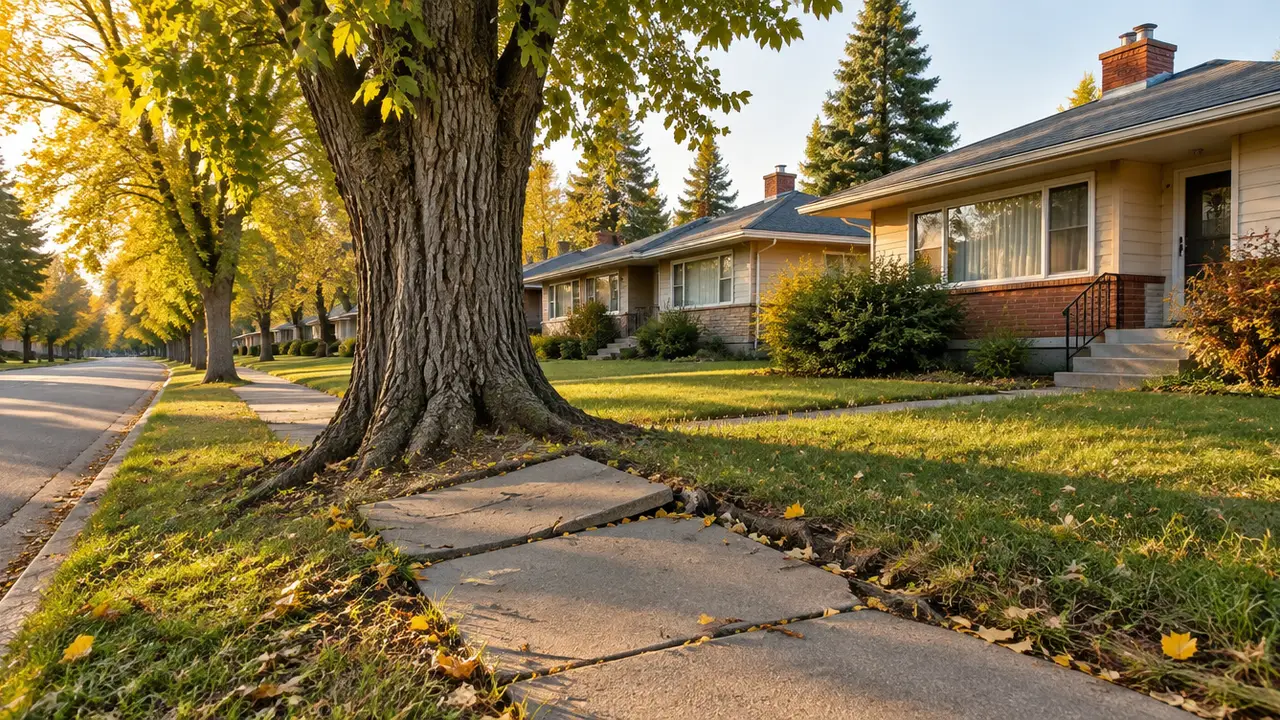
On a house lot, the hidden costs are more personal: a mature tree whose roots are cut by the trench, a heated driveway or interlocking patio, a retaining wall, a garden that took ten years to grow. Those are the reason trenchless often wins on a residential lateral even when the direct prices are close.
04 /How do safety and risk compare?
An open trench is one of construction's classic hazards. The Canadian Centre for Occupational Health and Safety lists cave-ins, falling equipment or soil, hazardous atmospheres, contact with buried services, and falls among the main risks, and says trenches 1.2 m (4 ft) deep or more need a protective system unless they are entirely in stable rock, while reminding employers to check their own jurisdiction's rules. A long, deep trench carries that risk along its whole length and for as long as it is open.
05 /What about noise, odour, time and settlement?
- Noise and vibration. Excavators, compactors and saw-cutting run the length of a trench. Trenchless noise concentrates at the pits: a pneumatic bursting head or ramming hammer can be loud, while lining is comparatively quiet.
- Odour. Styrene-based lining resins smell. Toronto Public Health says the odour can be detected at levels far below those linked to health effects and usually breaks down in a day or two, and advises closing windows and filling drain traps with water.
- Time out of service. Drains or water are off while the new pipe is connected, whichever method is used. Lining and bursting a lateral commonly fit in a day or two; a trench stays open until inspection and backfill.
- Settlement. Trench backfill can settle along the whole route; pits settle in patches. SUDAS notes that over-excavated bores can also settle, especially shallow ones.
- Emissions and hauling. A trench moves more soil, so more truck trips and more fill. Trenchless moves less, but lining equipment and drilling rigs have their own fuel use.
06 /When does open cut still win?
- The pipe is shallow and the surface is cheap to restore, such as lawn.
- The grade must change, such as a sag holding water, or the route must move.
- There are many connections close together, which would each need a pit anyway.
- The old pipe has collapsed and nothing can pass it.
- Services crowd the line so closely that displacement methods are unsafe.
Many real jobs combine the two: a short dig where it is unavoidable and a trenchless method for the rest. For planning, the network's 2026 ranges for a 15 to 25 m house lateral are about $12,000 to $35,000 or more for open cut, $9,000 to $28,000 for relining and $10,000 to $30,000 for bursting.
The cost guide breaks each option into its lines, and the Method Finder shows which trenchless methods your pipe can take. For a homeowner's view of the choice, see residential trenchless options.
07 /How do I measure disruption on my own job?
- Get the pit sketch
Ask each contractor to mark every pit, shaft, cleanout and lay-down area on a site plan, with sizes and depths.
- Count the connections
Every branch on a burst or slip-lined line adds a pit; lining reopens them from inside.
- Mark the surfaces
Note which pits land in lawn and which in driveway, walk or patio, and where trees stand over the route.
- Run the numbers
Enter the sketch into the Dig vs Trenchless Disruption Calculator to compare each proposal with a trench.
- Ask about time
How long each hole stays open, and how long drains or water are out of service.
Two contractors proposing the same method can plan very different sites, so compare sketches as carefully as prices.
FAQQuestions people ask
Is trenchless less disruptive than trenching?
Usually, because only access points are dug. The gap shrinks on short runs with many connections, where bursting or slip lining need a pit at each branch.
Is trenchless sewer repair worth the extra cost?
It often is when the pipe is deep or under driveways, trees or finished landscaping, because restoration is expensive. On a short, shallow lawn run, digging can cost less.
Does trenchless work damage lawns at all?
At the pits, yes, and equipment can mark turf. The strip between the pits is usually untouched.
Which is safer, open cut or trenchless?
Trenchless reduces the length of open excavation, which lowers cave-in exposure. It adds different risks, such as striking an unseen service, which locates and exposure manage.
How long is a street disrupted for municipal relining?
Typically much less than for open-cut replacement, because work is at manholes or small pits. Bypass pumping and connection reinstatement still need traffic control while they run.
NETWORKGo deeper across the HAUSE Sewer network
Sewer root removal cost in Canada: cutting, chemicals and permanent fixes
Sewer root removal cost in Canada for 2026: planning ranges for cable cutting, jetting, camera, lining, bursting and replacement, plus cycle-versus-fix math.
SewerQuotes.comTrenchless lining vs pipe bursting: cost, fit and trade-offs
Trenchless lining vs pipe bursting cost in Canada: 2026 CIPP and bursting ranges in CAD, line items, which defects each fixes and how to choose.
SewerCleaners.caWhat happens during a professional sewer cleaning visit
A step-by-step look at a professional sewer cleaning visit: arrival, questions, access, cleaning, flow testing, camera verification and the paperwork you keep.