Trenchless methods differ in four ways that matter: the sizes and run lengths they handle, how accurately they hold line and grade, the ground they tolerate, and the access they need. Lining and bursting work inside an existing pipe; directional drilling, auger boring, pipe ramming, microtunnelling and moling make a new hole, and only laser-guided microtunnelling and pipe jacking hold gravity-sewer grades closely.
- Size ranges overlap widely; accuracy, ground and access usually decide between methods.
- Microtunnelling and pipe jacking can hold line and grade to within about 25 mm; most other new-path methods are closer to ±1% of the bore length.
- Directional drilling handles long runs and curves but struggles to hold a flat gravity grade.
- Bursting and slip lining need a dig at every service connection; lining reopens connections from inside.
- Most figures here come from the Iowa SUDAS design manual and ASTM scopes and are typical ranges, not hard limits.
01 /How should trenchless methods be compared?
Compare them on the constraints your job cannot move. A gravity sewer needs a steady fall, so accuracy matters more than speed. A road crossing needs a casing strong enough for traffic loads, so the method must suit steel pipe. A lateral with four branches needs a plan for four connections. A river crossing needs length. Pick the constraint first, and the list of candidates shrinks quickly.
The numbers below come mainly from Chapter 14 of the Iowa Statewide Urban Design and Specifications (SUDAS) design manual, a public engineering manual with unusually specific ranges for each method, and from the scopes of the relevant ASTM practices. They are typical working ranges, converted to metric and rounded. Equipment keeps improving, and specialist contractors regularly work outside them, so treat an out-of-range job as a reason to ask questions, not as impossible.
02 /How do the renewal and replacement methods compare?
| Method | Size range | Bore afterwards | Connections | Main limit |
|---|---|---|---|---|
| CIPP, inverted | 50–2,743 mm (ASTM F1216: 2–108 in) | Slightly smaller | Reopened from inside | Needs an open, reasonably round path |
| CIPP, pulled in | 50–2,438 mm (F1743: 2–96 in) | Slightly smaller | Reopened from inside | Same; a calibration hose presses it out |
| CIPP, UV-cured glass liner | 100–1,830 mm (F2019: 4–72 in) | Slightly smaller | Reopened from inside | Pulled in, cured by UV light |
| Slip lining | Most economical on larger pipe | Smaller; annulus grouted | Dug up, new wye | Capacity loss |
| Close-fit liners | Product specific | Slightly smaller | Robotic or dug | Declining use in cold climates |
| Coatings | F2831: 13–914 mm metallic pressure pipe | Barely changes | Coated through | Not structural |
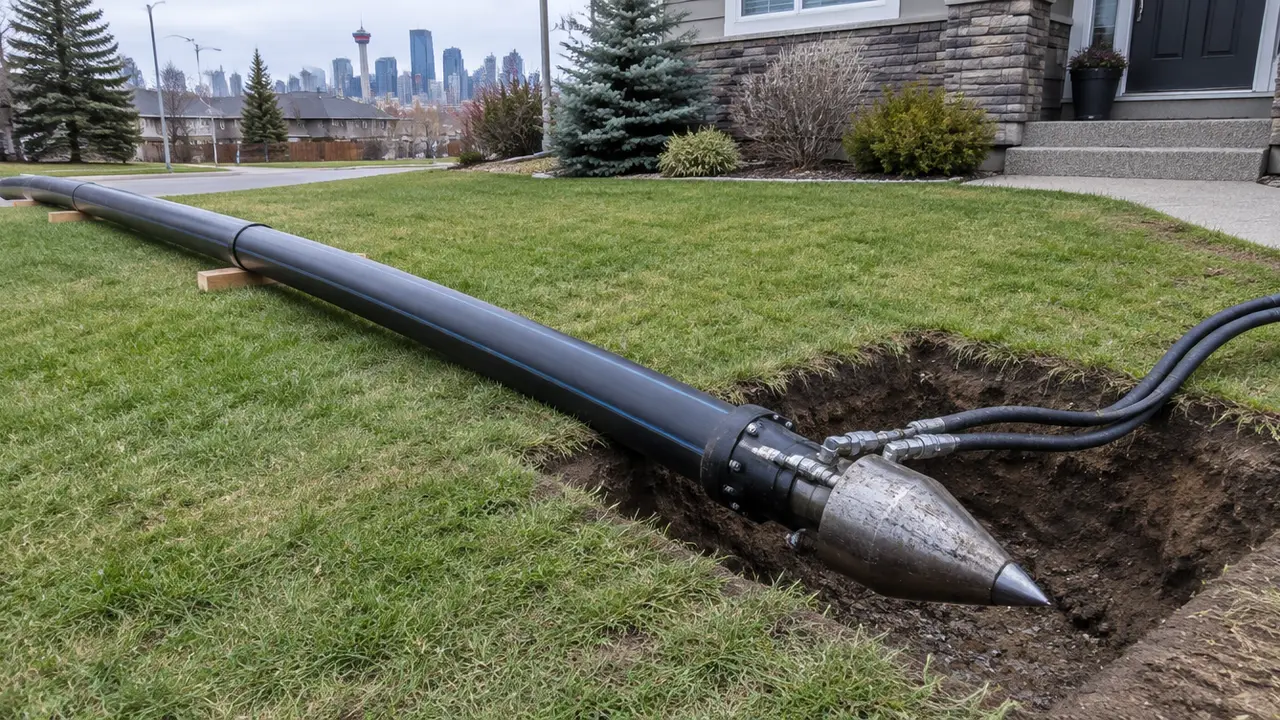
| Pipe bursting | 50–914 mm (SUDAS: 2–36 in) | Same or up to about three sizes larger | Dug up first | Heave, nearby services, sags, rock |
| Pipe splitting | Similar to bursting | Same or larger | Dug up first | For ductile iron, steel and plastic |
| Pipe reaming | Product specific | Same or larger | Dug up | Non-metallic hosts only; slurry |
SUDAS gives the normal bursting length as the 300 to 400 feet between manholes, about 90 to 120 m, and notes that upsizing of up to three pipe diameters or more has been done, with size-for-size the most common. It also notes that the new polyethylene pipe stretches during the pull and should relax for at least 24 hours before services are reconnected, a point that applies equally to polyethylene slip liners.
03 /How do the new-path methods compare?
| Method | Common sizes | Typical length | Accuracy | Ground |
|---|---|---|---|---|
| Mini directional drilling | Up to 254 mm (10 in) | Under about 180 m (600 ft) | 150–300 mm (6–12 in) | Clays, silts, sands ideal |
| Large directional drilling | 305–1,524 mm (12–60 in) | Over 600 m (2,000 ft) possible | About ±1% of length | Slower and less accurate in gravel and rock |
| Auger boring | 203–914 mm (8–36 in) | 53–69 m typical; over 180 m possible | ±1%; steered ±0.1% vertically | Boulders up to a third of the casing; not rock |
| Pipe ramming | 51–1,397 mm (2–55 in) | Under 46 m; up to about 91 m | Non-steerable, about ±1% | Most ground except solid rock |
| Slurry boring | 51–305 mm (2–12 in) | 12–23 m | ±1% up to about 18 m | Most ground; some owners prohibit it |
| Impact moling | Up to 152 mm (6 in) | 12–18 m | No control once started | Soft to medium compressible soil |
| Microtunnelling | 254–3,048 mm (10–120 in) | Long drives economical | Within about 25 mm | Wide range; boulders to 20–30% of diameter |
| Pipe jacking (man-entry) | 1,067 mm (42 in) and up | Extended with intermediate jacking stations | Within about 25 mm | Almost all ground with the right shield |
The accuracy column is the one owners overlook. A bore that can wander by one percent of its length is fine for a water line, which runs under pressure and does not care about small dips. For a gravity sewer at one or two percent slope, the same wander can eat most of the fall. SUDAS gives the example of a 12-inch sewer bored 200 feet on a 1% grade: with tolerances of ±0.2%, common for gravity sewers, the job would likely need an oversized casing or microtunnelling. Loosen the tolerance and a steered auger bore may do. The detail is in directional drilling for sewer lines and auger boring and pipe ramming.
04 /What access does each method need?
| Method | Access at the ends | Extra digs | Room at the surface |
|---|---|---|---|
| CIPP lining | Cleanout, manhole or one small pit | Usually none | Truck, boiler or UV train, wet-out area |
| Slip lining | Insertion trench and receiving pit | One per service | Fused pipe laid out in a line |
| Bursting and splitting | Launch and receiving pits | One per service | Fused pipe laid out; puller |
| Reaming | Drill rig set-up and a pit | One per service | Rig, fluid and cuttings handling |
| Directional drilling | Rig at the surface; exit point | Connection digs | Rig plus full pipe string length |
| Auger boring | Long bore pit and receiving pit | None | Casing sections, crane |
| Pipe ramming | Launch pit with rails and receiving pit | None | Casing sections, compressor |
| Microtunnelling | Jacking shaft and reception shaft | None | Control unit, slurry separation, crane |
| Impact moling | Two small pits | None | Compressor |
SUDAS describes an auger-boring pit as typically 26 to 40 feet long and 8 to 12 feet wide, about 8 to 12 m by 2.5 to 3.5 m, which surprises owners who picture a small hole. Large directional drilling set-ups can occupy an area as big as 150 by 250 feet. Put your own pit sizes into the Dig vs Trenchless Disruption Calculator to see how they compare with a trench.
05 /Which methods suit gravity sewers?
For renewal and replacement, any method that keeps the pipe open and round works on a gravity sewer, with the caveat that it keeps the existing grade. For new gravity lines, the short list is short.
- Microtunnelling and pipe jacking are built for it: laser-guided, steerable, and within about 25 mm of line and grade.
- Steered auger boring can hold about ±0.1% vertically, and an oversized casing lets the carrier pipe be adjusted to grade on chocks.
- Pipe ramming and unsteered auger boring install a casing roughly on line; the carrier is then set to grade inside it, which needs an oversized casing when tolerances are tight.
- Directional drilling can install a gravity line with generous fall, but SUDAS notes it can be difficult at small slopes and may not suit gravity pipelines.
- Moling and slurry methods are not used where accuracy matters, such as sanitary sewers.
06 /How do I narrow the list for my job?
- Name the job
Renew, replace, or new path. That removes two of the three families.
- Get the camera run
For an existing pipe, condition decides whether it can be lined, burst or must be dug.
- Check size and length
Compare your diameter and access spacing with the tables above.
- Check grade
For a new gravity line, compare the method's accuracy with the total fall.
- Check the ground and surroundings
Rock, cobbles, groundwater, nearby services and shallow cover each rule methods out.
- Count the digs
Connections and pit sizes can erase the ground savings on short runs.
The Trenchless Method Finder automates those steps against the same published ranges. For individual methods, read CIPP in the trenchless family, bursting, splitting and reaming, slip lining and microtunnelling. When you have a shortlist, request quotes for more than one method.
FAQQuestions people ask
What is the most accurate trenchless method?
Laser-guided microtunnelling and pipe jacking. SUDAS says installations within about one inch (25 mm) of line and grade are possible with either.
Which trenchless method handles the longest runs?
Large directional drilling rigs, which SUDAS describes installing pipe over more than 2,000 feet, and microtunnelling drives, which become economical as length increases.
Which trenchless methods reduce pipe size?
The renewal methods: CIPP, close-fit liners and coatings slightly, slip lining more. Bursting and splitting can keep the same size or go larger.
What is the cheapest trenchless method?
For short, small-diameter bores, SUDAS calls compaction methods such as moling normally the lowest-cost option. For pipe renewal it depends on the job, and slip lining is often economical on larger pipes.
Can one job use more than one method?
Yes. A dig at a sag with lining on either side, or a burst lateral with a directionally drilled water service in the same pit, are common combinations.
NETWORKGo deeper across the HAUSE Sewer network
Is trenchless sewer repair worth it? Lifespan, cost and when it fails
Is trenchless sewer repair worth it? How long lining and bursting last, when trenchless beats digging on cost, and the pipe conditions where it fails.
SewerRoots.caPermanent fixes for roots in sewer lines
Permanent fixes for roots in sewer lines: CIPP lining, sectional point repairs, pipe bursting and open-cut replacement compared by cost, lifespan and fit.
SewerInspector.caCommon sewer defects, explained by what they do to the pipe
Common sewer defects explained: roots, cracks, fractures, offset and separated joints, sags, deposits, holes and collapse, with severity and usual next steps.