Slip lining renews a pipe by pushing or pulling a smaller finished pipe, usually fused polyethylene, into the old one and normally grouting the gap between them. It is simple and durable but costs bore, and every service connection has to be dug up and remade. Close-fit liners are a variation: a pipe made folded or reduced goes in, then is heated and pressed tight to the old wall.
- Slip lining comes in three forms: continuous pipe, segmental sections, and spiral-wound profile strip.
- The Plastics Pipe Institute notes a polyethylene liner about 10% smaller in outside diameter than the host's inside diameter is often appropriate.
- A very smooth liner can partly offset the lost area, but capacity has to be checked, especially on small pipes.
- Services cannot usually be reopened from inside; each one is excavated and a new wye is fitted.
- Close-fit liners (fold-and-form, deformed-reformed) lose less bore, but SUDAS reports declining use in cold climates.
01 /What is slip lining?
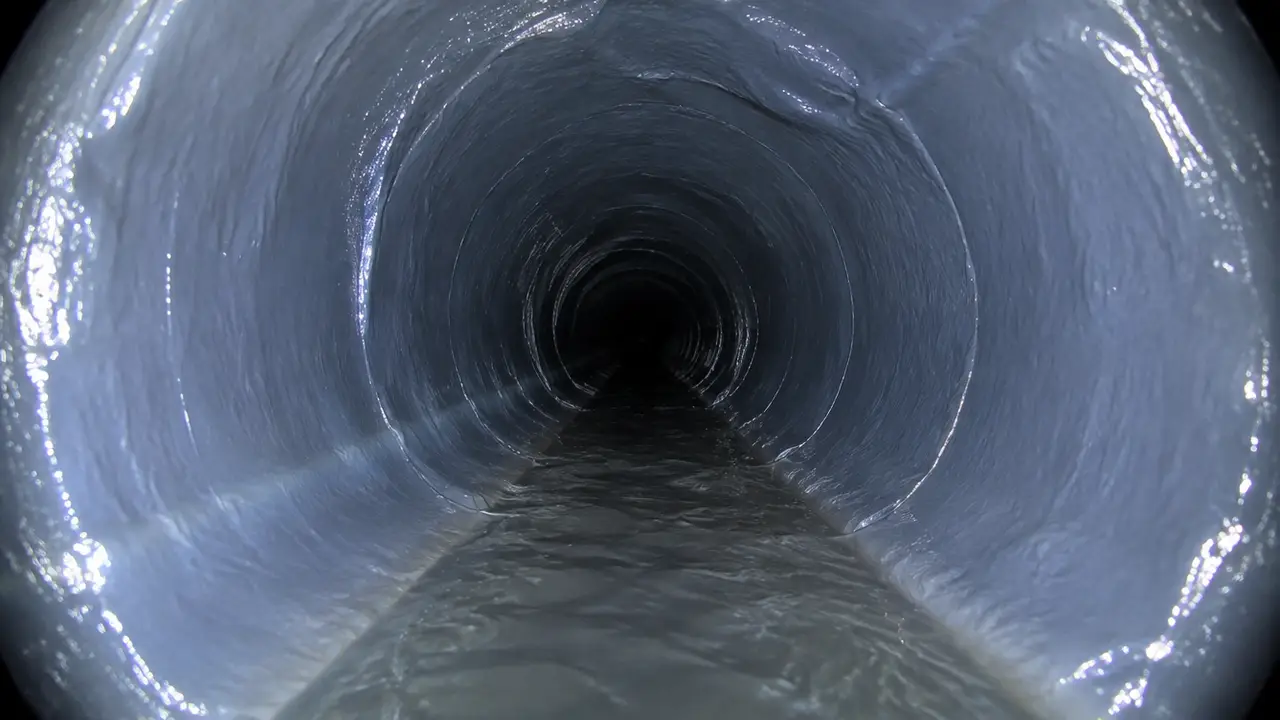
Slip lining is the oldest and simplest way to renew a pipe without digging it up: put a new pipe inside the old one. The US EPA's trenchless rehabilitation fact sheet describes a smaller-diameter liner inserted into the existing pipe, with the annular space, the ring-shaped gap between old and new, typically grouted to prevent leaks. The Iowa SUDAS design manual calls it one of the simplest techniques there is: push or pull a new pipe into the old, reconnect the services, and possibly grout the space between.
The finished result is a real pipe with its own wall, joints and rating, not a coating or a liner formed against the host. That makes slip lining predictable: the new pipe's strength is known before it goes in, and the old pipe mostly serves as a sleeve to guide it.
02 /What are continuous, segmental and spiral-wound slip lining?
| Form | What goes in | How | Typical use |
|---|---|---|---|
| Continuous | A long string of pipe, usually polyethylene fused end to end | Pulled in from an insertion trench by a winch or pushed | Sewers and water mains where the whole length can be laid out |
| Segmental | Short rigid or restrained-joint sections | Pushed in one at a time from a small pit, joint by joint | Larger sewers and culverts, often without bypassing the flow |
| Spiral wound | A plastic profile strip wound into a pipe inside the host | A winding machine at a manhole or pit | Larger sewers with limited surface space |
SUDAS explains why polyethylene dominates: it can be fusion welded into long, jointless strings that pull into place quickly. Rigid pipes such as vitrified clay, concrete, ductile iron and glass-fibre reinforced polymer mortar can instead be pushed in from a relatively small pit with jacking equipment. For those, the line stays open during insertion, so flow bypassing is not normally needed, and because the pipe is stiff on its own, grouting the gap matters less, though it is still usually done to lock the pipe in place.
03 /How is a continuous polyethylene slip liner installed?
- Clean and inspect
The host is cleaned and televised to find its narrowest point, offsets and every service connection.
- Dig the insertion trench
A starter trench at one end lets the pipe enter from the surface without a sharp bend.
- Fuse the string
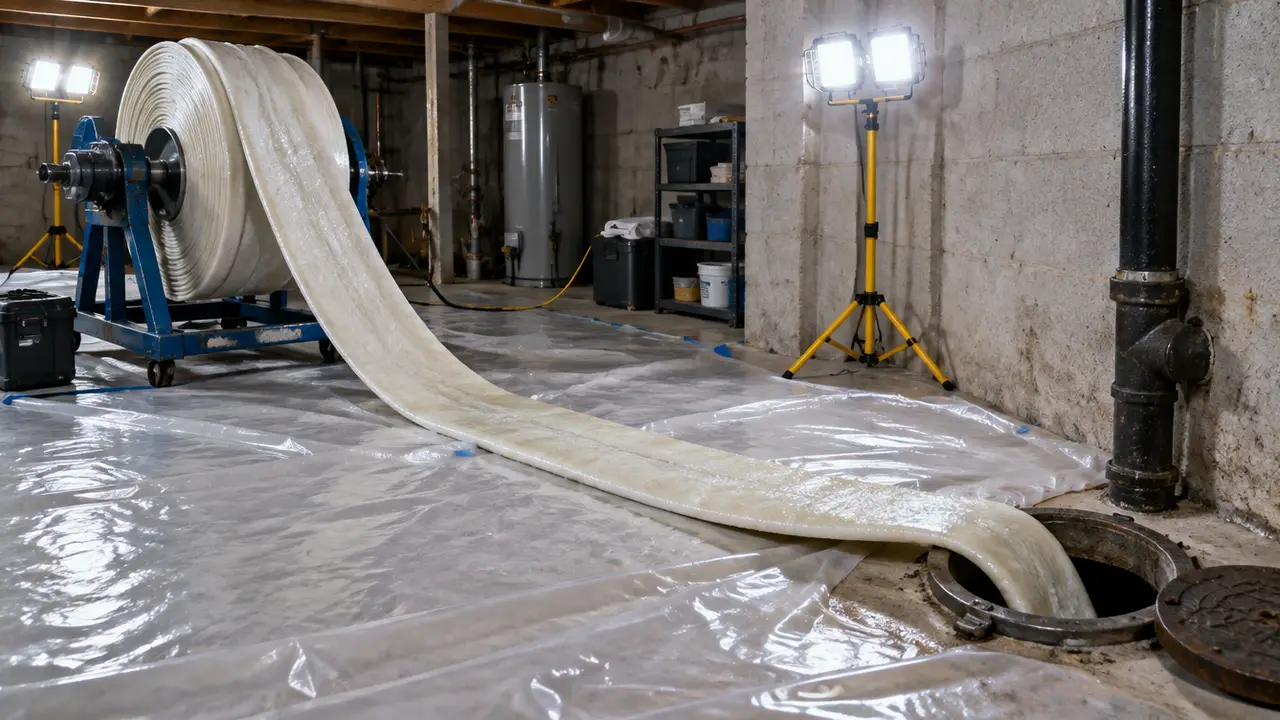
Polyethylene lengths are butt-fused into one continuous pipe as long as the run and laid out on the ground.
- Divert the flow
Sewage is bypassed around the section while the liner goes in.
- Pull it in
A cable through the host connects to a towing head on the liner, and a winch at the far end pulls it through.
- Let it relax
Polyethylene stretches under the pull and slowly recovers; SUDAS recommends at least 24 hours before services are reconnected.
- Grout and reconnect
The annulus is grouted and each service is excavated and joined to the liner with a new wye or saddle.
SUDAS singles out grouting as potentially the hardest part of the job, and relaxation as a common trap: if a service opening is cut before the liner has recovered, the pipe shrinks back and the opening slides past the connection. It also notes that black polyethylene is often specified with a light-coloured interior so later camera inspections are easier to read.
04 /How much capacity does slip lining cost?
The new pipe has to fit inside the old one at its narrowest point, so the outside diameter is chosen smaller than the host's inside diameter. The Plastics Pipe Institute's design guidance says a polyethylene liner with an outside diameter 10 percent smaller than the host's inside diameter will often be appropriate, and points out that the liner's very smooth wall improves flow characteristics compared with most old pipe materials. Whether that offsets the smaller area depends on the host and the liner's wall thickness, so a capacity check is part of any design.
That trade makes slip lining a natural fit for pipes with capacity to spare and a poor fit for lines that are already undersized. SUDAS suggests that if slip lining would cut capacity too far, cured-in-place lining or bursting should be considered instead, and it observes that for larger pipes, above about 42 inches, slip lining may be more economical than CIPP where there is capacity to spare.
05 /How are service connections handled?
This is slip lining's biggest practical cost on a street or a long lateral. SUDAS notes that service lines cannot normally be reconnected from inside the pipe as they can after CIPP lining; the connections are excavated and a new wye is installed on the liner. On very large pipes, above about 42 inches, crews may be able to re-establish services by entering the pipe.
The Plastics Pipe Institute describes the options for joining a lateral to a polyethylene liner: in-trench fusion of moulded or fabricated tees, sidewall fusion of branch saddles, electrofused spool pieces, and low-profile mechanical connectors. It also makes the point that deteriorated service connections are a leading cause of infiltration in gravity lines, so a slip-lining job that renews the main but leaves the connections leaking has not finished the work.
06 /Where does slip lining make sense?
- Culverts and storm sewers with spare capacity, where a segmental or continuous liner can be pushed through with little surface work. ASTM F585 covers polyethylene insertion into sanitary and storm sewers along their existing line and grade.
- Large sewers and trunks, where the lost area is a small share of the total and man-entry reconnection may be possible.
- Water mains relined with pressure-rated polyethylene, where the pipe string can be laid out and services reconnected in pits.
- Crossings that must stay open, since rigid segmental liners can go in without bypassing the flow.
It is usually a weak choice for a small house lateral: a 100 mm pipe cannot spare the bore, and the connection digs erase much of the trenchless benefit. For a lateral, compare CIPP lining and bursting. Slip lining versus bursting on a larger line comes down to capacity: bursting keeps or increases the size, slip lining costs some.
07 /What are close-fit liners?
Close-fit liners try to get slip lining's factory-made pipe without its lost annulus. The EPA fact sheet groups them as modified cross-section lining, including deformed-reformed, swagelining and rolldown methods, and notes that unlike CIPP they do not use resins to hold the liner in place. SUDAS describes the fold-and-form and deformed-reformed versions: a PVC or polyethylene pipe is folded into a U shape at the factory, coiled, pulled into the host, heated with steam or hot water until pliable, and rounded with pressure or a rounding device so it fits tight against the wall. Services are then reopened robotically or dug up.
SUDAS also reports that these methods, once common, are declining, especially in northern climates, because some formed liners developed a memory and crept back toward their folded shape over time, pulling away from the host and from service connections. That is a pointed caution for Canadian owners: ask for the product's track record in cold ground. The relevant ASTM documents include F1504 and F1947 for folded PVC, F1871 and F1867 for folded/formed PVC, and F1533 and F1606 for deformed polyethylene.
Slip lining and close-fit lining are priced by quote or tender; this site does not publish a residential range for them. See the trenchless standards guide for how the practices fit together, and screen your line with the Method Finder.
FAQQuestions people ask
What is slip lining a pipe?
Installing a smaller, finished pipe inside an existing one and normally grouting the gap. The old pipe becomes a sleeve and the new pipe carries the flow.
What size pipe do you use to slip line?
One that fits the host at its narrowest point. For polyethylene, the Plastics Pipe Institute says an outside diameter about 10% less than the host's inside diameter is often appropriate.
Is slip lining better than pipe bursting?
It depends on capacity. Slip lining keeps the old pipe and costs bore; bursting removes the old pipe and can go larger. Both need digs at service connections.
Do you have to grout a slip liner?
Usually. Grouting restrains the liner and adds stiffness. SUDAS says it is not required for ductile iron liners and optional for PVC, depending on the old pipe.
Can a culvert be slip lined?
Yes, culverts and storm sewers are common candidates when they have capacity to spare. The road authority or owner sets the design and grouting requirements.
NETWORKGo deeper across the HAUSE Sewer network
Sewer pipe lining cost: what a CIPP liner should cost in Canada
Sewer pipe lining cost in Canada (2026): CIPP liner ranges in CAD for full laterals and single sections, the line items, cost drivers and quality checks.
DrainAugering.caAuger cutting heads, and which one to use for each clog
Auger cutting heads explained: bulb, spade, C-cutter, grabber and root saw heads, what each clears, which risk damaging old pipe, and a head selection chart.
SewerRoots.caRoots in clay and concrete sewer pipe: why older neighbourhoods suffer most
Why roots invade clay and concrete sewer pipe in older Canadian neighbourhoods: joint spacing, mortar and jute seals, mature trees, and how to plan repairs.
SOURCESSources and further reading
- US EPA — Collection Systems O&M Fact Sheet: Trenchless Sewer Rehabilitation (EPA 832-F-99-032)
- Plastics Pipe Institute — Design guidelines for slip lining with polyethylene pipe
- ASTM F585 — Insertion of flexible polyethylene pipe into existing sewers
- Iowa SUDAS Design Manual, Chapter 14: Trenchless Construction