Cured-in-place pipe (CIPP) lining renews a pipe by installing a flexible tube soaked in thermosetting resin, pressing it against the old wall, and curing it hard with hot water, steam or ultraviolet light. The result is a jointless new pipe inside the old one, slightly smaller in bore, following the old route and grade. Branch connections are then reopened from inside.
- Three ASTM practices cover the main CIPP variants: inverted tubes (F1216), pulled-in tubes (F1743) and UV-cured glass tubes (F2019).
- CIPP is the renewal method that reaches the widest range of sizes, from small laterals to large sewers.
- The liner copies the old pipe's shape and grade, so a sag stays and a collapse must be dug first.
- Water mains use pressure-rated structural liners, a separate product class with its own specifications.
- Engineering depth on liners and resins lives on SewerRelining.ca; this page places CIPP among the other methods.
01 /What is cured-in-place pipe?
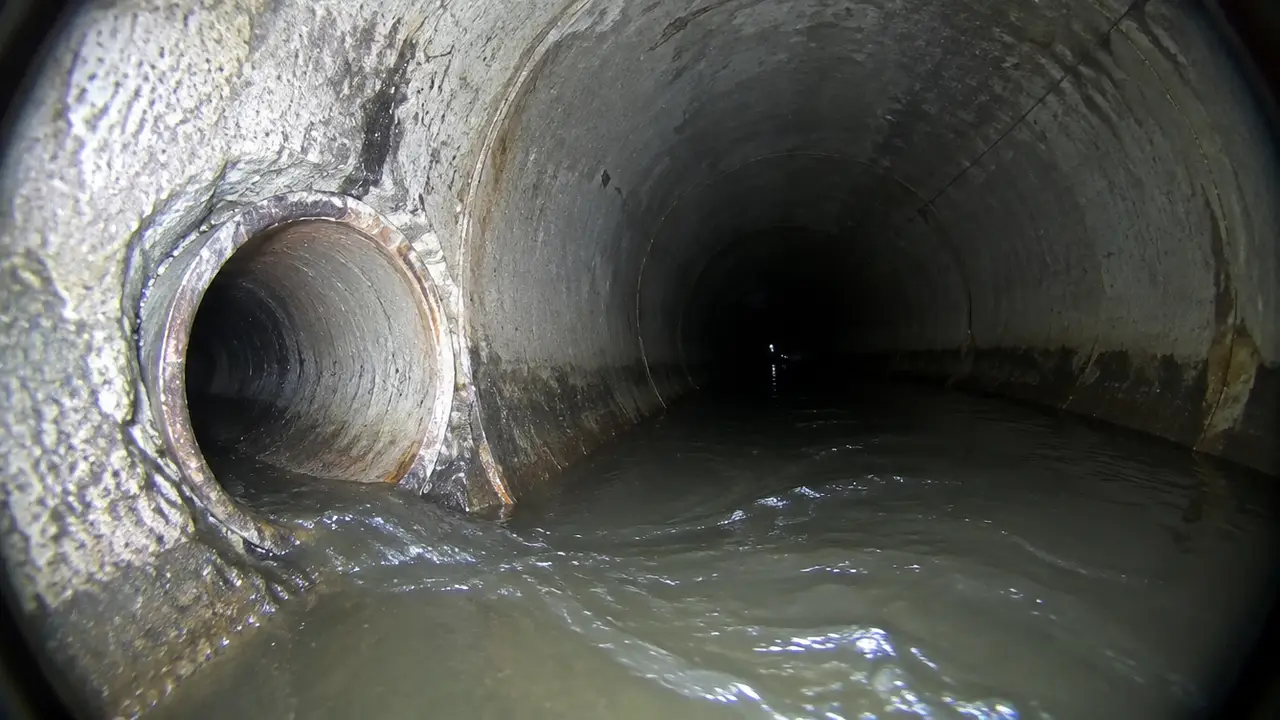
Cured-in-place pipe is a new pipe that is formed inside an old one. A tube of felt or glass fibre, sized to the host pipe, is saturated with a liquid resin that hardens when triggered. The tube goes into the pipe soft, is pressed against the wall so it takes the pipe's shape, and is then cured until it is rigid. The ends are trimmed, connections are cut open, and the pipe returns to service with a continuous wall and no joints between the ends.
The US EPA's trenchless rehabilitation fact sheet describes the principle simply: a flexible fabric liner coated with thermosetting resin is inserted into the pipe and cured to form a new liner, installed either by winching it in or by inverting it in place. The Iowa SUDAS design manual adds a practical detail from ASTM F1216: because pressure squeezes some resin out into cracks and joints, the tube is loaded with an extra 5 to 10 percent of resin by volume beyond saturation.
02 /What are the main CIPP variants?
| Variant | How it goes in | Cure | ASTM practice and size scope |
|---|---|---|---|
| Inverted liner | Turned inside out into the pipe by water head or air pressure | Hot water, steam or light-initiated resin | F1216: 2–108 in (50–2,743 mm) |
| Pulled-in liner | Winched in, then inflated by inverting a calibration hose inside it | Hot water or steam (light-initiated in the current edition) | F1743: 2–96 in (50–2,438 mm) |
| UV-cured glass liner | Winched in, inflated with compressed air | Ultraviolet light train pulled through | F2019: 4–72 in (100–1,830 mm) |
Inversion and pulling-in behave differently at leaks. SUDAS notes that the inverted method may be better suited to pipes with heavy infiltration at joints and cracks, because the resin-soaked felt is pressed straight against the host, while a pulled-in liner keeps an outer membrane that can limit resin migration into defects. For defects that are mainly structural, it says the two work equally well. On a house lateral, the choice is often set by the access: a small inverter at a cleanout, or a pull-in where both ends can be reached.
03 /How is a CIPP liner designed?
Design starts with the condition of the host pipe. ASTM F1216 divides host pipes into two classes. A partially deteriorated pipe can still carry the soil and traffic loads on its own; the liner mainly has to resist groundwater pressure and bridge holes and joints. A fully deteriorated pipe is assumed to carry nothing, so the liner is designed to take the soil, water and live loads itself. The EPA's 2009 white paper on rehabilitation describes the same idea in terms of liners that either stand alone as replacements or act as semi-structural linings that rely on the host for overall stability.
Wall thickness follows from that choice, the pipe's ovality, the depth and water table, and the tested strength and stiffness of the resin and tube. That calculation is engineering, not a rule of thumb, and it is where CIPP gets its reputation for being as good as the design and installation behind it. Resin chemistry, cure schedules, wet-out, and the thickness equations are covered on our sister site SewerRelining.ca.
04 /Where does CIPP fit among the other methods?
CIPP is the default renewal method when the old pipe is open and roughly round and the goal is to stop leaks, roots and corrosion without digging. Its strengths show clearly against the alternatives.
Where the camera shows an isolated defect, a short sectional liner may be all that is needed; that repair-scale choice is covered on TrenchlessSewerRepair.ca. For the full comparison with other methods, see every method compared, and for the harder cases, bursting, splitting and reaming.
05 /Is CIPP used on water mains?
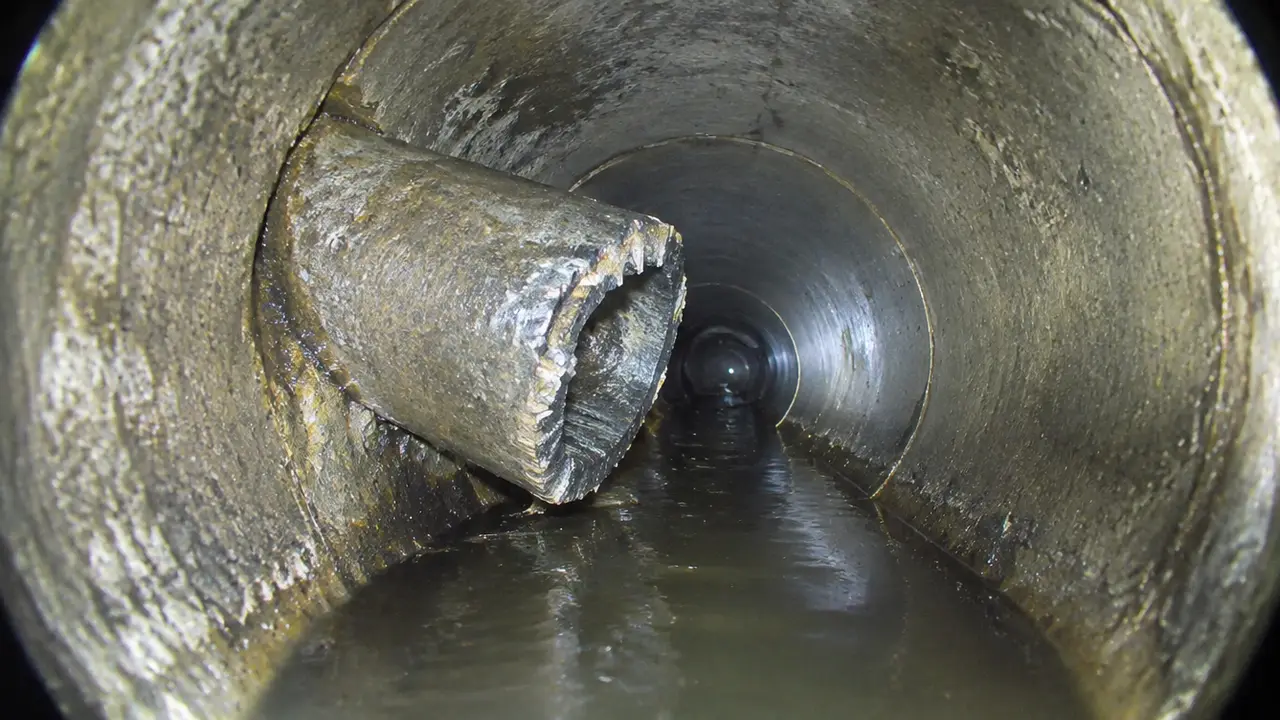
Yes, but as a distinct product. A water main carries internal pressure, so its liner must be rated for it and made of materials approved for drinking water. The City of Toronto describes structural lining as inserting a liner in the existing watermain to help form a new pipe wall, a pipe within a pipe that extends the main's life, and says it is best suited where open-cut costs and traffic disruption are significant. Toronto Water's specification TS 7.60 covers structural, tight-fit CIPP lining of watermains up to and including 400 mm, aims for a 50-year design life, requires the liner to carry NSF/ANSI Standard 61 approval for potable water, and includes temporary bypass lines and water services while the main is out.
Small metal water piping inside buildings is sometimes renewed with a blown-in epoxy coating instead, which is a barrier film rather than a structural liner; see epoxy and spray-applied coatings. For water services to a house, replacement by pulling or bursting is more common; see moling and pipe pulling.
06 /What should neighbours and owners expect during lining?
Lining is quiet compared with excavation, but it is not invisible. Flow in the pipe has to stop or be bypassed while the liner goes in and cures, so drains may be out of service for part of a day on a house lateral and for longer on a main with bypass pumping. Crews set up at the access point with a truck, a boiler or UV equipment, and the liner itself.
Many sewer liners use styrene-based resins, and the smell is noticeable. Toronto Public Health explains that styrene gives off a glue-like or plastic odour during curing that people can detect at levels far below those associated with health effects, and that it usually breaks down in the air within one to two days. Its advice is practical: close windows and doors, pour a litre or two of water into every drain so the traps are full, and get fresh air if a strong odour builds indoors.
Calgary's pilot lining program for sanitary service pipes gives a sense of the homeowner side: residents are told in person shortly before work starts, and asked not to run taps, flush, or use washing machines and dishwashers while the liner is being installed. Ask your contractor for the equivalent instructions in writing.
07 /What does CIPP cost, and how long does it last?
For a house lateral of 15 to 25 m, the network's 2026 planning range for full-length relining is about $9,000 to $28,000, built from setup of $500 to $2,000, roughly $500 to $1,200 per metre, cleaning of $400 to $2,500 and $300 to $1,200 for each reopened connection. A single sectional liner starts around $2,500 to $6,500. Municipal mains are priced by tender, and SUDAS notes that lining large quantities in one contract lowers unit costs because mobilisation is such a large share of the price.
On service life, SUDAS states that a cured-in-place liner's expected life is generally accepted to be 50 years. That is a design expectation, not a warranty, and it assumes a properly designed, cured and inspected liner. The final camera run is your evidence: it should show a smooth, fully cured wall, no wrinkles blocking flow, clean-cut connections and sealed ends. The cost guide compares lining with the other methods, and the Method Finder checks whether it suits your pipe.
FAQQuestions people ask
How does trenchless pipe lining work?
A resin-soaked tube is inverted or pulled into the old pipe, pressed against its wall, and cured with hot water, steam or UV light. The hardened liner becomes a new jointless pipe inside the old one.
How long does trenchless pipe lining last?
SUDAS says a CIPP liner's expected service life is generally accepted to be 50 years. Actual life depends on design, cure quality and what goes down the drain.
Is UV-cured lining better than steam or hot water?
Neither is better in general. UV uses glass-reinforced tubes and cures quickly with a light train; hot water and steam suit felt tubes and many sizes. Ask which practice the product follows.
Does CIPP lining shrink my pipe?
Slightly, by the liner's wall thickness. The smooth, jointless wall often offsets some of that loss, but the capacity should still be checked on small or busy lines.
Can a lined pipe be cleaned with a jetter later?
Generally yes, with pressures and nozzles suited to lined pipe. Ask the installer for the maintenance limits and keep them with the final video.
NETWORKGo deeper across the HAUSE Sewer network
Sewer lining for tree roots: will a CIPP liner stop them for good?
Sewer lining for tree roots: how a CIPP liner seals root-damaged joints, which lines qualify, preparation, weak points at the ends, and planning costs.
SewerQuotes.comSewer pipe lining cost: what a CIPP liner should cost in Canada
Sewer pipe lining cost in Canada (2026): CIPP liner ranges in CAD for full laterals and single sections, the line items, cost drivers and quality checks.
SewerJetting.caSewer jetting machines explained: types, specs, hoses and what they cost
Sewer jetting machines compared: pressure-washer kits, electric drain jetters, cart, trailer and truck rigs, hose sizes and rough 2026 price ranges in CAD.
SOURCESSources and further reading
- ASTM F1216 — Rehabilitation by inversion and curing of a resin-impregnated tube
- US EPA — White Paper on Rehabilitation of Wastewater Collection and Water Distribution Systems (EPA/600/R-09/048)
- City of Toronto — Styrene used in sewer relining
- City of Toronto — Watermains (renewal methods)
- Toronto Water — TS 7.60, Cured-in-Place Pipe Lining of Watermains (Nov. 2023)
- City of Calgary — Sanitary lateral lining program