Small service lines, such as a house water service, are usually replaced trenchless in one of three ways: an impact mole or push rod makes a small new bore between two pits, a pulling or splitting head drags new tubing through the path of the old line, or a mini directional drill steers a new route. All suit pressure lines, which tolerate small dips; none of the compaction methods is used for gravity sewers.
- Compaction methods (push rods, rotary rods and impact moles) displace soil rather than remove it and are limited to about 6 inches and 40 to 60 feet (SUDAS).
- Keep about one foot of cover per inch of bore to avoid heave, and remember frost depth sets the minimum for water services.
- An impact mole cannot be steered once started; rocks can deflect it.
- Pulling and splitting heads replace a service along its old path; mini-HDD makes a new, steered path.
- Private service lines are generally not located by one-call services, so a private locate may be needed before any bore.
01 /Which trenchless methods suit small service lines?
Small services are pipes of a few centimetres, such as water services, gas services, irrigation lines and conduits for power or data. They are short, they run under pressure or carry cables, and they rarely need precise grade. That opens up cheap, simple methods that would be useless on a sewer. The Iowa SUDAS manual lists water service lines alongside electric and communications cables, gas lines and irrigation systems as typical compaction-method installations.
| Method | Path | How it works | Typical limits |
|---|---|---|---|
| Push rod | New | A machine pushes or pulls a solid rod through the soil, displacing it; a reamer can enlarge the hole | Rods about 1⅜ to 1¾ in; short runs |
| Rotary rod | New | Like the push rod, but the rod turns like a drill bit as it advances | Short runs |
| Impact mole | New | A torpedo-shaped pneumatic hammer drives itself through the ground, then pulls a cable or pipe back | About 6 in or less; about 12 to 18 m |
| Pulling or splitting head | Old | A cable or rods through the old service drag a head that bursts or splits it, with new tubing behind | Depends on the old pipe and fittings |
| Mini directional drilling | New, steered | A small rig steers a pilot bore, then pulls the pipe back | Up to about 10 in; under about 180 m |
02 /How does impact moling work?
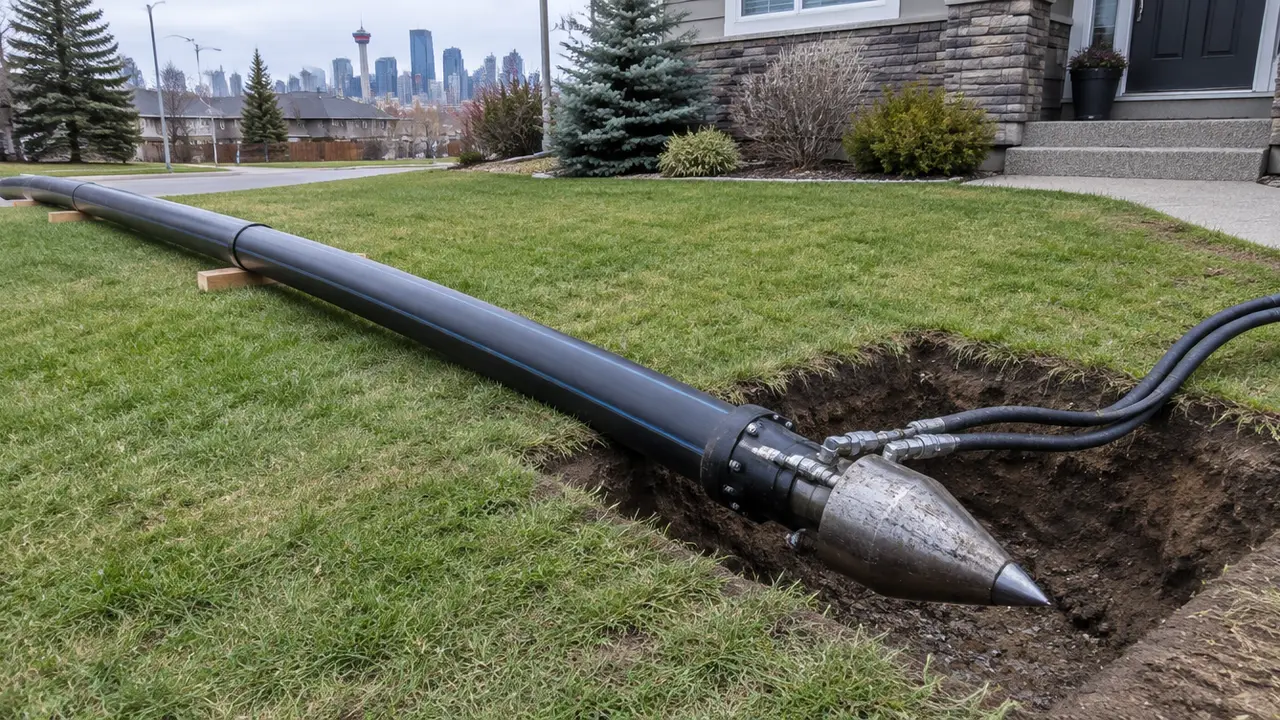
SUDAS describes the percussion method, or impact moling, as a self-propelled, normally pneumatic tool: a torpedo-shaped body with a reciprocating hammer in the nose that drives it forward through the ground. Depending on the soil, it typically travels from about 3 inches to 4 feet per minute. When it exits into the receiving pit, it is removed and its air lines are used to pull a cable back through the bore, which then pulls the pipe in. A rigid pipe can simply be pushed through the open hole.
Because the mole compacts the soil around the hole instead of removing it, two limits follow. Size is capped by how big a hole the ground will accept, typically 6 inches or less, and the ground above can heave. SUDAS gives a rule of thumb of one foot of cover for every inch of bore diameter. Accuracy is the other limit: once launched, the mole cannot be steered, rocks and boulders can knock it off course, and the maximum practical bore length is typically 40 to 60 feet, about 12 to 18 m. SUDAS says compaction methods are not normally used for lines needing high accuracy, such as sanitary sewers, and are normally the lowest-cost trenchless option for short, small bores.
03 /How does pipe pulling replace a service on its old path?
Replacing a service where it already runs has an advantage: the path is known and already clear of obstacles. A cable or string of rods is threaded through the old service between a pit at the street end and a pit or basement opening at the house end. A head attached to it breaks, splits or drags out the old pipe, and new tubing, commonly polyethylene or another pipe the water utility accepts, follows behind. This is the service-scale version of the static-pull bursting and splitting that SUDAS describes for larger pipes, where the pulling force alone breaks the host.
- Brittle old pipe is broken outward, as in bursting.
- Tough or ductile pipe, such as copper or galvanized steel, is slit open with a splitting head, or in some systems pulled out whole; ask which approach the contractor uses.
- Fittings and repairs on the old line, such as couplings or clamps, can snag the head; a pit at each one may be needed.
- The meter, shut-off and curb stop connections are made in the pits, under the water utility's rules.
The same approach works on small sewer laterals in some cases, but a gravity sewer brings back all the grade and connection issues described in bursting, splitting and reaming.
04 /When is mini directional drilling the better choice?
When the old route is a problem: under a new addition, too shallow for frost, in the way of a planned foundation, or simply unknown. SUDAS describes mini-HDD rigs as all-in-one units that fit on a single trailer, installing pipes up to about 10 inches over drives under about 600 feet, and says small installations by mini-HDD are very economical and often less expensive than open cut even in open ground. Accuracy of about 6 to 12 inches is plenty for a pressure service.
Directional drilling in more depth, including why it struggles with gravity sewers, is in directional drilling for sewer lines.
05 /What should owners check before a small bore?
- Find out who owns what
Water services are usually split between the utility and the owner at a curb stop or property line, but the split varies by city. Confirm it with your utility before hiring anyone.
- Locate, including private lines
In Alberta, submit a request to Utility Safety Partners at least three full working days before digging. Its homeowner page says customer-owned water and sewer service lines are not registered with it, so a private locator may be needed.
- Check the depth rules
Water services must stay below frost; your municipality sets the minimum cover. A mole or drill should not bring the new line shallower than the old.
- Check the ground
Moling needs soft to medium compressible soil; cobbles and rock favour drilling or pulling.
- Ask about permits and inspection
Most municipalities require a permit and inspection for a new or replaced water service, and some require specific pipe materials.
06 /How does this fit the bigger water line picture?
A water service replacement is often driven by something else: low pressure from scaled galvanized pipe, a leak, or a lead service line that a city is replacing on its side. Those questions, including city programs, materials and who pays, belong to our sister site WaterMainReplacement.ca. This page covers only the trenchless methods themselves.
Small-service boring is rarely priced as a trenchless method on its own; it is part of a service replacement quote, and this site publishes no separate range for it. Use the Trenchless Method Finder with a pressure line, your pipe size and run length to see how moling, drilling and ramming rate, and the Disruption Calculator to compare pits with a trench. When you are ready, send the details.
07 /What goes wrong with small bores?
- The mole wanders. Stones or a change in soil deflect it, and it surfaces in the wrong place or strikes something. Short runs and careful set-up limit this.
- The ground heaves. Too little cover over a compaction bore pushes up lawns, walks or slabs.
- The new pipe is damaged. Tubing dragged through a broken old pipe can be scored; ask what pipe class is used and how it is protected.
- A fitting snags. Old couplings and repair clamps stop a pulling head; a pit at each one fixes it.
- Utilities are struck. Unlocated private lines are the biggest risk on a residential lot.
Each of these is managed by locates, sensible pit placement and the right method for the ground, not by luck.
FAQQuestions people ask
Can a water line be replaced without digging up the yard?
Usually, with a pit at each end. The new line is pulled along the old path or bored on a new one by a mole or a small directional drill.
What is a trenchless pipe puller?
A machine that pulls a cable or rods through an old pipe to drag a bursting or splitting head, with new tubing following behind. It is common on small services.
How far can an impact mole go?
SUDAS gives a maximum practical length of about 40 to 60 feet, roughly 12 to 18 m, because a mole cannot be steered once started.
Can a mole be used for a sewer line?
Not for a gravity sewer. SUDAS says compaction methods are not normally used for lines needing high accuracy, such as sanitary sewers.
Can copper water pipe be replaced trenchless?
Yes. Copper does not shatter, so it is split with a bladed head or pulled out, depending on the system, and new pipe follows.
NETWORKGo deeper across the HAUSE Sewer network
How to remove tree roots from a sewer line yourself, and when to stop
How to remove tree roots from a sewer line yourself: the tools that work, a step-by-step cut from the cleanout, safety rules and when to call a pro.
DrainAugering.caHow to auger a main sewer line from the cleanout
How to auger a main sewer line from the cleanout: opening it safely, house traps, machine setup, cable size, running technique and stop conditions.
SewerQuotes.comIs trenchless sewer repair worth it? Lifespan, cost and when it fails
Is trenchless sewer repair worth it? How long lining and bursting last, when trenchless beats digging on cost, and the pipe conditions where it fails.