Yes, a sewer line can be directionally drilled, but a gravity sewer is the hardest pipe to do it with. HDD steers a pilot bore, reams it larger and pulls pipe back through drilling fluid. It excels at pressure lines, force mains, services and long crossings. Typical accuracy of about ±1% of bore length can swallow the whole fall of a flat gravity sewer, so it suits gravity lines only when the slope is generous.
- HDD happens in three stages: a steered pilot bore, back-reaming to about 1.5 times the pipe diameter, and pullback of the product pipe.
- SUDAS separates mini-HDD (up to about 10 inches, under about 600 feet) from larger rigs (12 to 60 inches, over 2,000 feet possible).
- Accuracy is typically about ±1% of bore length for HDD and 6 to 12 inches for mini rigs; the Iowa manual notes HDD may not suit gravity pipelines.
- Force mains, water services and gas lines are HDD's home ground because pressure lines tolerate small dips.
- Shallow or under-reamed bores can heave the surface or crack pavement; a rule of thumb is a foot of cover per inch of pipe.
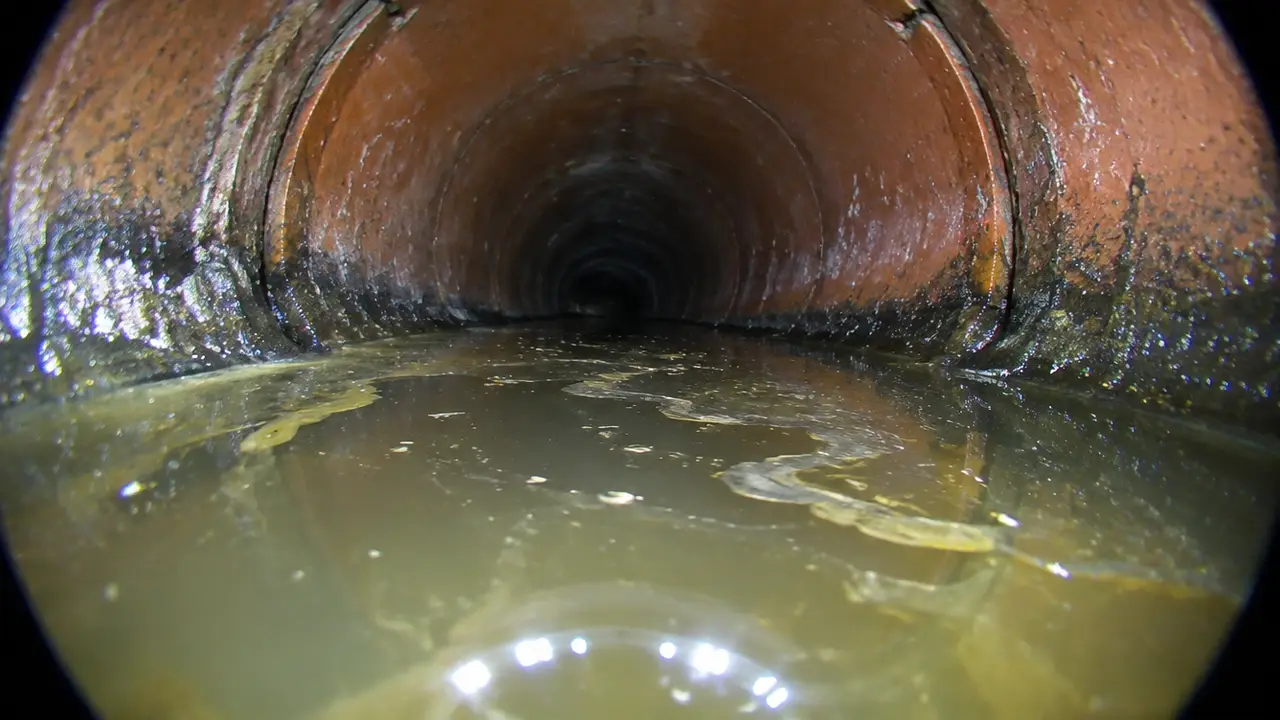
01 /How does horizontal directional drilling work?
Directional drilling builds a curved bore from the surface, under an obstacle, and back up, then pulls the pipe through it. The Iowa SUDAS design manual describes the process in three stages that apply whatever the rig size.
- Pilot bore
The rig, usually set up on the ground surface, pushes a drill string into the ground at a shallow angle, about 12 degrees. At depth the head is steered along a sag-shaped curve, levels out, and runs to the exit pit or curves back up to the surface.
- Steering and tracking
A slanted plate called a duckbill, or a bent section of drill stem on larger rigs, pushes the head sideways when the string is held still; rotating continuously drills straight. A transmitter behind the head, the sonde, is tracked from above by a walkover receiver, or by a wired system where the surface cannot be reached.
- Back-reaming
For all but small products, a back reamer replaces the drill head and is pulled back through the pilot hole, enlarging it. SUDAS gives the rule of thumb of reaming to about 1.5 times the product pipe's diameter. Drilling fluid mixes with the cuttings into a slurry that holds the hole open.
- Pullback
The product pipe, assembled into one full length and laid out in line with the bore, is pulled into the hole. The slurry left around it stays in place to support the bore.
ASTM F1962 is the standard guide for maxi-HDD placement of polyethylene pipe under obstacles, including river crossings, and its scope names sewer lines among the uses. It describes HDD as a trenchless method intended to minimise surface damage, restoration and disruption of traffic with little interruption of other lines.
02 /What is the difference between mini and maxi directional drilling?
| Mini-HDD | Large (maxi) HDD | |
|---|---|---|
| Pipe size | Up to about 254 mm (10 in) | About 305 to 1,524 mm (12 to 60 in) |
| Bore length | Under about 180 m (600 ft) | Over 600 m (2,000 ft) possible |
| Equipment | All-in-one unit, often on tracks, one trailer | Up to about 10 trailers; a site as large as 150 by 250 ft |
| Accuracy | Within about 150 to 300 mm (6 to 12 in) | About ±1% of bore length |
| Typical work | Power, telecom, gas and water services | River and highway crossings, transmission mains |
Nearly every residential job is mini-HDD. SUDAS notes that small-diameter installation by mini rigs is very economical and often less expensive than open cut even in wide open areas, while large HDD is specialised work that only pays off on long bores.
03 /Why is a gravity sewer hard to directionally drill?
Because a gravity sewer works only if it falls continuously in one direction, and HDD's accuracy is measured in a percentage of bore length that can be larger than that fall. SUDAS says directional drilling can be difficult for installing products at small slopes and therefore may not be suitable for gravity pipelines, while noting that it can be done.
Work the arithmetic for your own line. A 30 m lateral at 2% falls 0.6 m end to end. A bore held to ±1% of its length could be ±0.3 m off at the far end, half the available fall. A dip of that size in the middle of the run becomes a belly that holds water and solids, the same defect people pay to have dug out of old laterals. At 1% slope over 60 m, the ±0.6 m tolerance equals the full fall. Mini rigs on short bores do better, but the point stands: the flatter and longer the gravity line, the worse the fit.
Methods built for gravity grade are compared in auger boring and pipe ramming and microtunnelling and pipe jacking. The Method Finder runs this tolerance check against your slope and length automatically.
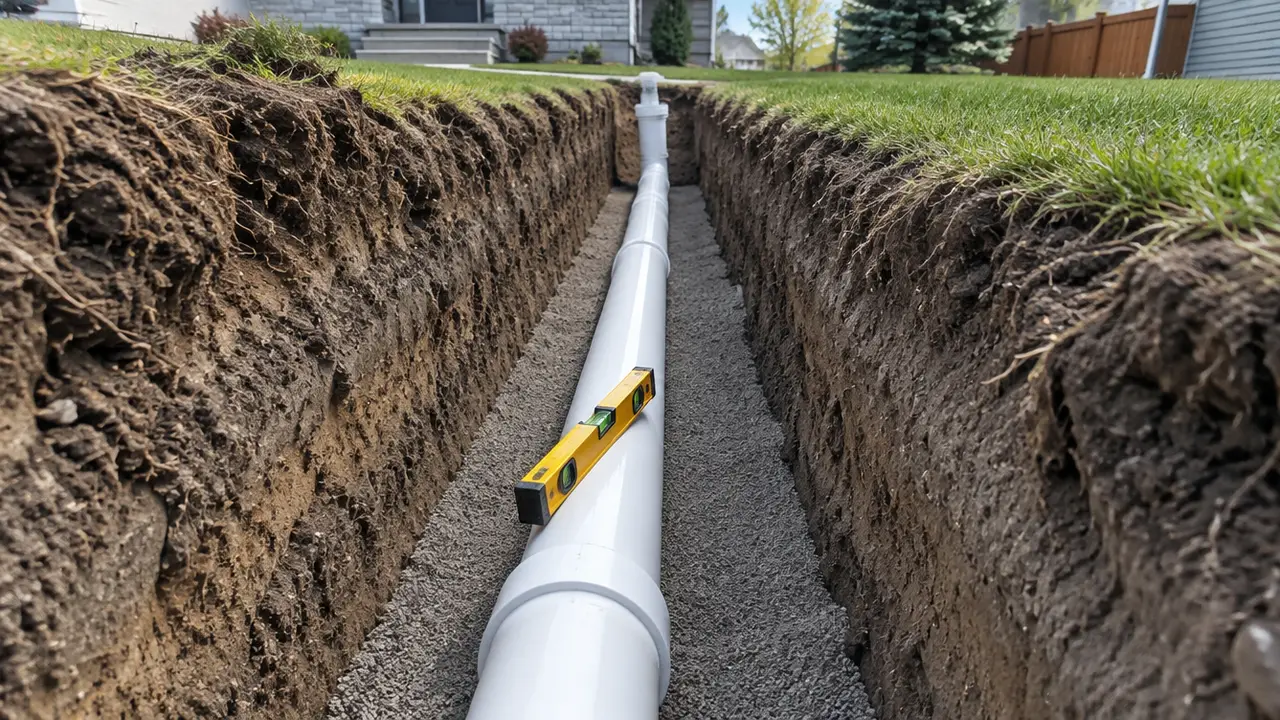
04 /Where does directional drilling fit sewer and drainage work well?
- Sewage force mains. Pumped sewers run under pressure, so small dips do not matter. SUDAS lists sewer force mains among HDD's typical uses.
- Water services and mains. A new service can be drilled from the street to the house on a new route, leaving the old one abandoned. See moling and pipe pulling for the other small-service options.
- Gravity lines with generous fall. A storm outfall or drainage line dropping steeply toward a ditch or creek can tolerate HDD's accuracy.
- Crossings. Under a road, railway, river or protected area, HDD can pass far below an obstacle with entry and exit well clear of it.
- Casings and conduits. A drilled casing can carry a carrier pipe set to grade inside it, when there is room to adjust.
SUDAS names steel and HDPE as the most common materials installed by HDD, with PVC, copper and other flexible materials also used. Fused HDPE suits pullback because the string has no bells to snag and can bend through the bore's curves.
05 /What can go wrong with a directional bore?
| Problem | What happens | Prevention |
|---|---|---|
| Frac-out | Drilling fluid under pressure escapes to the surface or into a waterway | Fluid pressure and volume control; a contingency plan near water |
| Heave | An under-reamed hole forces fluid and soil outward during pullback | Ream to about 1.5 times the pipe's true outside diameter, including bells |
| Pavement cracking | Shallow bores under roads crack the surface | About one foot of cover per inch of pipe (SUDAS rule of thumb) |
| Strikes | The head hits an unlocated gas, power or water line | Locates, and exposing marked lines by hand where required |
| Grade errors | A gravity line ends up with dips or backfall | Tolerance written into the contract; camera and survey checks |
SUDAS makes a telling point about heave: contractors sometimes size the hole from the pipe's nominal diameter and forget wall thickness, bells or other protrusions, and if the rig can pull hard enough, drilling-fluid pressure can build until the ground lifts. Its photo of a cracked pavement over a shallow bore is a reminder that trenchless does not mean no risk to the surface.
06 /What does directional drilling cost for a sewer or water line?
This site does not publish a planning range for residential directional drilling, because prices depend so heavily on length, diameter, ground, the number of connection pits and the rig. SUDAS observes that mini-HDD is economical enough to beat open cut on many small installations, and that large HDD becomes economical only as bores get longer. Treat any HDD quote as a scope to read carefully: it should give the bore length and depth, the pipe material and pressure class, the entry and exit locations, the tolerance, fluid disposal, and how connections at each end are made.
Compare the ground each option opens with the Dig vs Trenchless Disruption Calculator, and see every method compared for the alternatives. When you have a route in mind, request quotes that price at least two methods.
FAQQuestions people ask
Can you directional bore a sewer line?
Yes, but it suits force mains and steep gravity lines far better than flat gravity sewers. HDD accuracy of about ±1% of the bore length can equal the whole fall of a sewer laid near minimum slope.
What is directional drilling, explained simply?
A rig steers a drill head underground along a curved path, enlarges the hole, and pulls a pipe back through it, all from entry and exit points at the ends.
How deep should a directional bore be under a driveway?
SUDAS gives a rule of thumb of about one foot of cover for every inch of pipe diameter to avoid heave and pavement cracking. Frost depth and utility clearances also apply.
Is directional drilling cheaper than digging a trench?
For small pipes and cables it often is, according to SUDAS, even in open areas. For gravity sewers, the added grade risk and connection pits change the comparison.
What happens to the old pipe when a new line is drilled?
Nothing, unless the scope says otherwise. HDD makes a new path, so the old pipe is abandoned in place, filled, or removed separately, as the owner requires.
NETWORKGo deeper across the HAUSE Sewer network
Auger Cable Sizer: pick the cable, head and machine before you start
Auger Cable Sizer: choose the line, the distance to the clog and the clog type to get drum or sectional cable, length, head, machine class and a pro flag.
SewerJetting.caSewer jetting machines explained: types, specs, hoses and what they cost
Sewer jetting machines compared: pressure-washer kits, electric drain jetters, cart, trailer and truck rigs, hose sizes and rough 2026 price ranges in CAD.
SewerRoots.caSewer lining for tree roots: will a CIPP liner stop them for good?
Sewer lining for tree roots: how a CIPP liner seals root-damaged joints, which lines qualify, preparation, weak points at the ends, and planning costs.