Trenchless sewer technology is any way of renewing, replacing or installing an underground pipe from a few access points instead of digging along its whole length. It splits into three families: renewal methods that build a new wall inside the old pipe, replacement methods that break or remove the old pipe and pull a new one along its path, and new-path methods that bore a fresh route.
- "Trenchless" is a category, not a method; ask which technique a quote actually means.
- Renewal keeps the old pipe as a host and slightly shrinks the bore; replacement can keep or increase the size; new-path methods choose their own route.
- Renewal and replacement inherit the old grade, so a sag in the old pipe usually survives them.
- Most methods still need some excavation: cleanouts, pits, shafts, or a dig at each service connection.
- The camera inspection comes first because the old pipe's condition rules methods in or out.
01 /What does "trenchless" actually mean?
Trenchless means the pipe work happens underground between access points while the ground in between is left alone. The access points might be a cleanout inside a basement, a manhole in the street, a pit dug beside the foundation, or a deep shaft at each end of a tunnel drive. Everything else, from lawn and driveway to road and river, stays where it was.
The International Society for Trenchless Technology (ISTT), a global umbrella for national trenchless societies, frames the field as installing, rehabilitating and inspecting underground utilities while keeping surface disruption low. Its North American affiliate, the North American Society for Trenchless Technology (NASTT), runs regional chapters that cover every Canadian province: British Columbia; the Northwest chapter for Alberta, Saskatchewan and Manitoba; and the Great Lakes, St. Lawrence and Atlantic chapter for Ontario, Quebec and the Atlantic provinces.
The phrase is used loosely in quotes and advertising. A contractor who says "we do trenchless" might mean a cured-in-place liner, a bursting head, a directional drill, or a short sectional patch. Those methods have almost nothing in common apart from the absence of a long trench, so the first useful question is always: which trenchless method, and why that one?
02 /What are the three families of trenchless methods?
Sorting by what happens to the existing pipe makes the field manageable. It also predicts the two properties owners care about most: what happens to the bore, and whether the route and grade can change.
| Family | Old pipe | Bore afterwards | Route and grade | Main methods |
|---|---|---|---|---|
| Renew in place | Stays and becomes the host | A little smaller | Unchanged | CIPP lining, slip lining, close-fit liners, coatings |
| Replace on the old path | Broken outward, split, ground up or pushed out | Same or larger | Unchanged (except some microtunnel-based methods) | Bursting, splitting, reaming, pipe eating and ejection |
| Build on a new path | Not used; left, abandoned or removed separately | Whatever is designed | New, to the accuracy of the machine | Directional drilling, auger boring, pipe ramming, microtunnelling, pipe jacking, moling |
The US EPA's fact sheet on trenchless sewer rehabilitation (EPA 832-F-99-032) groups the rehabilitation side into four techniques: pipe bursting, sliplining, cured-in-place pipe and modified cross-section lining. It notes that every one of them except bursting reduces the pipe's diameter, and that most need the sewage flow bypassed while the work is done. Those two facts explain a lot of the trade-offs you will read about on this site.
03 /How do renewal methods work?
Renewal builds a new pipe wall against, or just inside, the old one. The old pipe does not have to be sound, but it does have to be open enough for material to pass and round enough for the new wall to sit properly.
- Cured-in-place pipe (CIPP). A felt or glass-fibre tube soaked in resin is inverted or pulled into the pipe, pressed against the wall, and hardened with hot water, steam or ultraviolet light. See CIPP in the trenchless family.
- Slip lining. A smaller finished pipe, usually polyethylene, is pushed or pulled in and the gap around it is normally grouted. See slip lining and close-fit liners.
- Close-fit liners. A thermoplastic pipe made in a folded or reduced shape is pulled in, then heated and pressurised until it fits the old wall tightly.
- Coatings. Epoxy, polyurea or cement-based materials are sprayed, spun or blown onto the inside of the pipe or manhole. Some are barrier films; a few are marketed as structural. See epoxy and spray-applied coatings.
Because the new wall follows the old pipe, renewal keeps every bend, dip and belly the old line had. It also covers every branch connection, which then has to be reopened, usually by a remote cutter working from inside.
04 /How do replacement methods work?
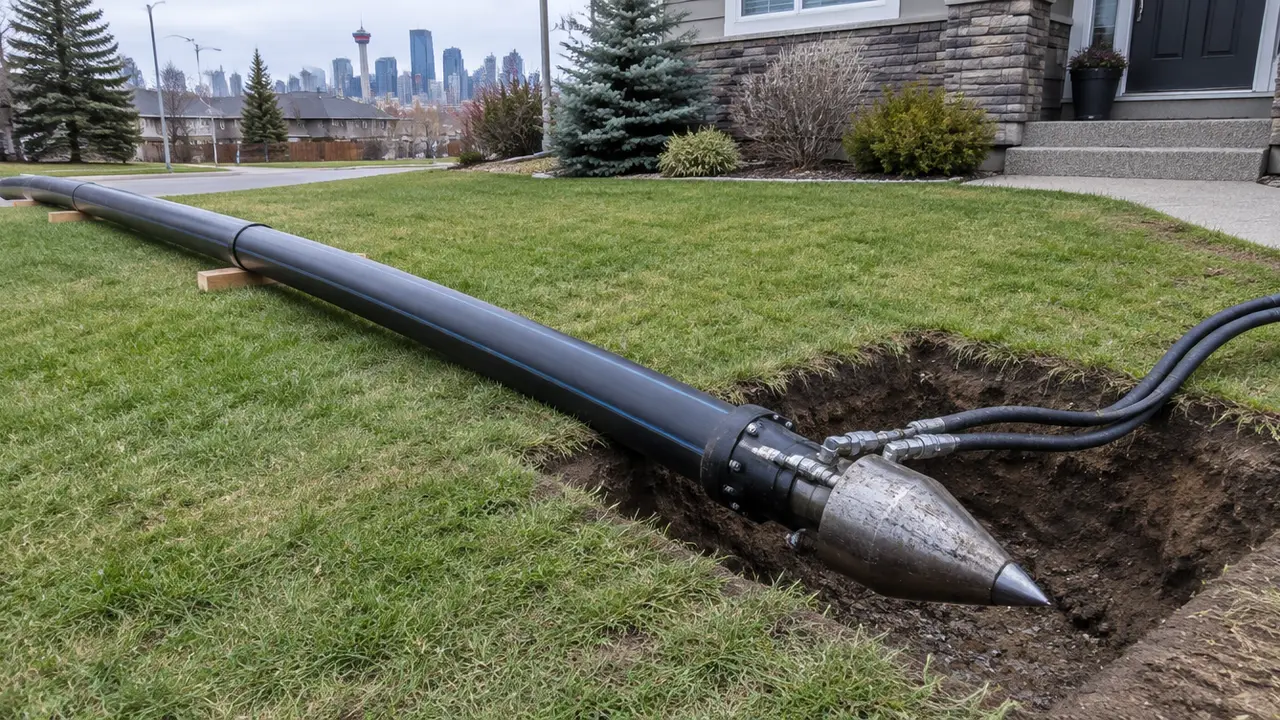
Replacement destroys or removes the old pipe as the new one goes in, so the new line is not limited by the old bore. Pipe bursting pulls a cone-shaped head through the old pipe, fracturing brittle materials such as clay and cast iron and pushing the pieces into the soil while new pipe follows. Splitting does the same for pipe that stretches rather than cracks, using blades. Reaming uses a modified directional-drilling rig to grind non-metallic pipe and flush the cuttings out. Pipe eating and pipe ejection, on larger sewers, use microtunnelling or jacking equipment to crush or push out the old pipe.
The path still follows the old pipe, so a head pulled through a sagging line settles into the same sag. Replacement also moves soil: even a same-size burst pushes the ground outward, which is why depth, nearby services and ground type matter. The overview is in bursting, splitting and reaming, and bursting in depth lives on PipeBursting.ca.
05 /How do new-path methods work?
New-path methods make a new hole and install pipe in it, which is how most road, rail and river crossings are built. They differ mainly in how they are steered and how they deal with the soil.
| Method | How the hole is made | Steering | Typical use |
|---|---|---|---|
| Horizontal directional drilling | Pilot bore, then back-reaming in drilling fluid | Steered and tracked | Pressure lines, services, long crossings |
| Auger boring | Steel casing jacked forward, spoil augered back | Little or none; some steered systems | Casings under roads |
| Pipe ramming | Open steel casing hammered in | None | Casings under rail and embankments |
| Microtunnelling | Remote boring machine pushed by jacked pipe | Laser-guided | Gravity sewers on tight grade |
| Impact moling | Pneumatic mole compacts a small hole | None | Small services over short runs |
Because the route is new, grade is only as good as the method's accuracy. That is why directional drilling a sewer line is harder than drilling a water service, and why cities use microtunnelling and pipe jacking for gravity trunks.
06 /Is trenchless always less disruptive?
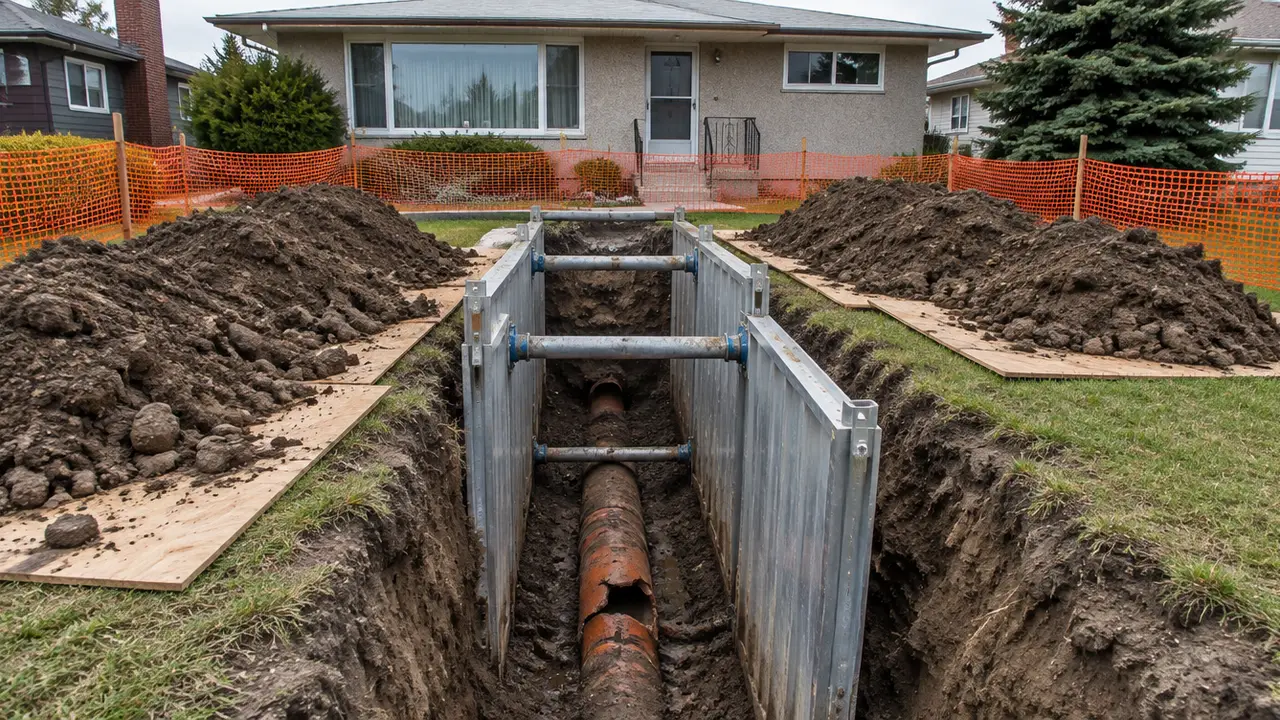
Usually, but the gap varies more than advertising suggests. Lining from an existing cleanout may disturb nothing outdoors. Bursting and slip lining each need a pit at both ends and a dig at every service connection, and on a short run with several branches the pits can add up to about as much ground as a narrow trench. Directional drilling needs room at the surface to lay out the whole pipe string before pullback.
Trenchless also shifts risk rather than removing it. Bursting pushes soil toward nearby services; drilling can strike an unlocated line or push drilling fluid to the surface; lining releases resin odour and depends on a good cure. Open cut exposes everything and lets the crew see what they are doing. Put numbers on the ground side of the trade with the Dig vs Trenchless Disruption Calculator, and read the wider trade-offs in trenchless vs open cut disruption.
07 /What decides which method a job gets?
- The job. Renew what is there, replace it, or build something new.
- The old pipe's condition, from a recorded camera run: roots and cracks, breaks, collapse, sags, or corrosion.
- Size and length between access points, compared with each method's working range.
- Grade needs. Gravity sewers need a steady fall; pressure lines do not.
- Ground and groundwater: soft soil, cobbles, rock, or running sand.
- What sits above and beside the pipe: pavement, trees, buildings, and other utilities.
- Connections, which drive pit counts for some methods and reinstatement work for others.
The Trenchless Method Finder runs those questions against published limits. For a single cracked joint on a house lateral, the repair-scale decision is covered on TrenchlessSewerRepair.ca. When you know what you need, request quotes.
FAQQuestions people ask
What does trenchless pipe mean?
It describes pipe renewed or installed without a continuous trench, from access points at the ends. The pipe itself can be ordinary polyethylene, PVC or steel; "trenchless" describes how it got there.
Is trenchless technology new?
No. Pipe jacking, auger boring and cured-in-place lining have long track records, and national trenchless societies have existed for decades. What changes is equipment size, steering and materials.
Does trenchless work on water lines as well as sewers?
Yes. Bursting, pulling, slip lining, pressure-rated liners, coatings and directional drilling are all used on water services and mains, with potable-water materials and testing.
Can trenchless fix a sewer that sags?
Renewal and replacement methods follow the old grade, so a sag usually stays. The common answer is a short dig at the sag, with a trenchless method for the rest of the line.
Why do contractors disagree about which method to use?
Partly because each crew owns different equipment, and partly because several methods can genuinely fit the same pipe. Ask each one to explain why the others were ruled out.
NETWORKGo deeper across the HAUSE Sewer network
Trenchless lining vs pipe bursting: cost, fit and trade-offs
Trenchless lining vs pipe bursting cost in Canada: 2026 CIPP and bursting ranges in CAD, line items, which defects each fixes and how to choose.
SewerJetting.caWhat is hydro jetting, and how does it clean a sewer line?
What hydro jetting is: how a sewer jetter uses rear-facing jets to pull a hose up the line, scour the pipe wall and flush debris out. Plain physics.
DrainAugering.caWhat drain augering is, and how a spinning cable clears a clog
Drain augering explained: how a rotating steel cable reaches, bores through and retrieves a clog, what it clears well, and where augering stops working.