Trenchless replacement removes the old pipe as the new one goes in. Bursting fractures brittle pipe and pushes the pieces into the soil; splitting slices open pipe that stretches instead of cracking; reaming grinds non-metallic pipe and flushes it out; pipe eating and ejection use tunnelling or jacking gear on larger sewers. All follow the old path, and most can install the same size or larger.
- The main advantage over lining is capacity: replacement does not shrink the bore and can upsize it.
- Which head is used depends on the old pipe: brittle clay, cast iron, asbestos cement and plain concrete burst; ductile iron, steel and plastic are split.
- The path follows the old pipe, so grade problems usually come along unless the method is microtunnelling-based.
- Every service connection is dug up and disconnected before the pull, and polyethylene should relax before it is reconnected.
- Soil displacement means heave and nearby-service risk; SUDAS flags deteriorated utilities within two to three pipe diameters.
01 /Why replace rather than line?
Because some pipes are too broken, too small or too misshapen to be a good host. A liner copies whatever it is installed in and reduces the bore; a replacement method throws the old pipe away and leaves a new, full-size pipe in its place. The Iowa SUDAS design manual puts the main advantage plainly: compared with lining and slip lining, bursting does not lose capacity and can increase it significantly by upsizing.
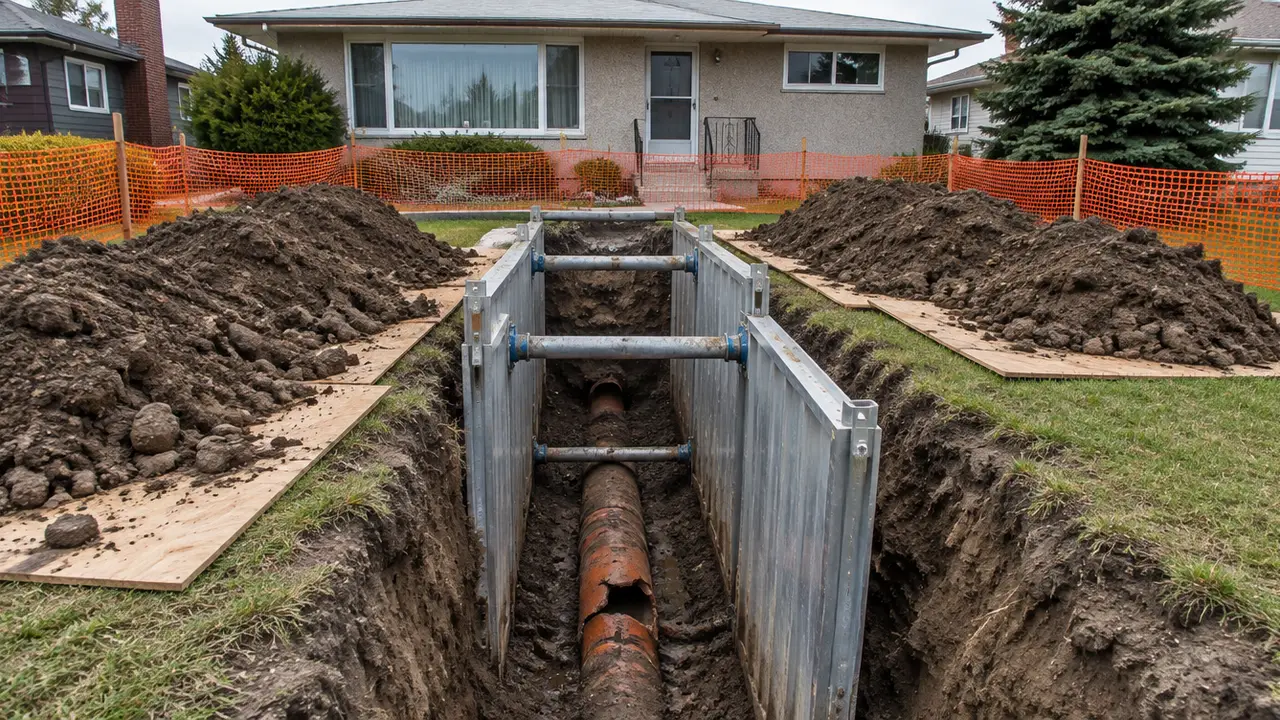
The trade is that replacement disturbs more. It needs pits at both ends and at every service connection, it pushes or removes soil around the pipe, and it can affect other utilities nearby. On a house lateral, those effects are the reason a contractor asks so many questions about depth, gas lines and what is under the driveway.
02 /What kinds of bursting are there?
SUDAS describes several classes of bursting system and notes that many of them are patented processes, with contractors paying a licence fee to use them. They differ in where the breaking force comes from.
| System | Where the force comes from | Notes |
|---|---|---|
| Pneumatic bursting | A percussion head, like an impact mole, hammers the pipe while a winch keeps tension on it | Described by SUDAS as the most commonly used system |
| Static pull | Pulling alone; the cone turns tension into radial force | Large pulling forces, often with rods instead of cable |
| Hydraulic expansion | A head that expands outward in steps, then is pulled forward | Breaks a section at a time |
| Implosion (pipe crushing) | A head around the pipe crushes it inward, then a cone pushes the pieces out | A variation for some hosts |
| Pipe splitting | Rotary slitter wheels cut, a blade splits, the pipe is spread open | For ductile iron, steel and plastic that do not fracture |
| Rigid pipe replacement | Jacks push rigid pipe sections in behind the breaking head | Allows clay, concrete or ductile iron as the new pipe |
For how each head behaves on a house lateral, the pit layouts and the upsizing arithmetic, see our sister site PipeBursting.ca, which covers bursting in depth.
03 /Which old pipes can be burst, and which must be split?
The rule is about brittleness. SUDAS lists the pipes typically suited to bursting as vitrified clay, cast iron, asbestos cement and plain (unreinforced) concrete, adds that lightly reinforced or badly deteriorated reinforced concrete may also be replaced, and says ductile iron, steel and plastic are not suitable for bursting but can be replaced by splitting. The US EPA fact sheet on trenchless rehabilitation describes the expansion head pushing the existing pipe outward until it cracks, which is why a material that stretches instead of cracking needs blades.
- Clay and cast iron. The classic bursting hosts. Cast iron laterals under basements are usually a separate conversation, because bursting under a slab risks heave.
- Asbestos cement. Bursts, but the fragments stay in the ground and any cutting at the pits needs asbestos precautions under provincial rules.
- Plastic. PVC and ABS can stretch and tear rather than shatter, so splitting heads are used.
- Ductile iron and steel. Split open with slitter wheels and a blade; the old pipe ends up folded around the new one.
- Bituminous fibre (Orangeburg). Often crushes flat; a camera run decides whether a head can pass.
04 /What is pipe reaming, and how is it different?
Reaming removes the old pipe instead of pushing it into the ground. SUDAS describes it as a modified version of the back-reaming used in directional drilling: a drill string is fed through the existing pipe and attached to a special reaming head, which is pulled back through the pipe while it crushes and pulverises the old material. The fragments and any extra soil removed for upsizing are carried out in a slurry, and the new pipe follows the reamer.
Because less soil is pushed aside, reaming is sometimes proposed where heave or nearby services are a worry. The trade is fluid handling: the slurry has to be captured, separated and disposed of properly, and a crew needs a plan for returns reaching the surface.
05 /What are pipe eating and pipe ejection?
Both are larger-diameter techniques built on tunnelling equipment. In pipe eating, SUDAS explains, a modified microtunnelling machine crushes the existing pipe and removes it, along with any excess soil, back through the new pipeline in slurry while new pipe is jacked in behind; unlike bursting, it allows line and grade adjustments. In pipe ejection, new pipe sections are jacked against the old pipe, pushing it out into the reception pit piece by piece, which only works if the old pipe is sound enough to take the jacking force.
These are municipal tools for sewers big enough to justify shafts and a tunnelling machine. For how microtunnelling itself works, see microtunnelling and pipe jacking.
06 /What limits trenchless replacement?
| Limit | What SUDAS reports | What it means for you |
|---|---|---|
| Pipe size | About 2 to 36 inches, and growing | Most laterals and many municipal sewers qualify |
| Run length | Normally 300 to 400 feet, the spacing of manholes | About 90 to 120 m between pits |
| Upsizing | Size-for-size most common; up to three pipe diameters or more has been done | Bigger upsizing moves more soil |
| Nearby utilities | Potential for damage within 2 to 3 pipe diameters if they are deteriorated | Expose and protect services close to the line |
| Heave | Most likely when the pipe is shallow or already large pipes are upsized | Careful under pavement and near structures |
| Services | Excavated and disconnected before bursting; new PE should relax at least 24 hours | A pit per connection and temporary service |
Grade is the other big limit. Bursting, splitting and reaming follow the old pipe, so a belly usually survives. A common answer is a hybrid: dig and relay the sag, and burst or line the rest. SUDAS also notes that the new polyethylene pipe is commonly specified about 10 percent thicker to allow for scarring by fragments, and often with a light-coloured interior so future camera inspections are easier to read.
07 /When does replacement make more sense than digging?
SUDAS is refreshingly blunt: open-cut replacement is normally preferred and cheaper than bursting when the pipe is shallow and the excavation causes no major inconvenience. Bursting gains a significant advantage as depth, and the cost of excavating to it, becomes a big part of the job. On a residential lateral, the same logic applies with a twist: the surface matters as much as depth, because a driveway, mature tree or finished landscaping costs far more to rebuild than lawn.
For planning, the network's 2026 range for bursting a 15 to 25 m lateral is about $10,000 to $30,000, against $12,000 to $35,000 or more for open cut. Quotes are built from setup, new pipe at roughly $550 to $1,300 per metre, and $1,500 to $6,000 for each pit, so connection pits move the price quickly.
Run your line through the Trenchless Method Finder to see how bursting, splitting and reaming rate against its material, condition and ground, and count the pits with the Disruption Calculator. The full price breakdown is in the cost guide.
FAQQuestions people ask
What is the difference between pipe bursting and pipe splitting?
Bursting fractures brittle pipe such as clay or cast iron. Splitting cuts open pipe that would stretch instead, such as ductile iron, steel or plastic, using slitter wheels and a blade.
Does pipe bursting leave the old pipe in the ground?
Yes. The fragments are pushed into the surrounding soil. Reaming and pipe eating are the replacement methods that remove the old pipe.
Can pipe bursting make a pipe bigger?
Yes. Size-for-size is most common, but SUDAS reports upsizing of up to three pipe diameters or more. Larger upsizing pushes more soil and raises heave risk.
What is a trenchless pipe splitter?
A splitting head with cutting wheels and a blade that slices a tough pipe lengthwise and spreads it open so the new pipe can follow. It is used where a bursting cone would only stretch the pipe.
Is pipe reaming the same as directional drilling?
It uses a directional drilling rig, but it follows an existing pipe and grinds it up rather than boring a new path through undisturbed ground.
NETWORKGo deeper across the HAUSE Sewer network
Ductile iron pipe, cement linings and how pipelines are cleaned
What ductile iron pipe is, how it is made, why it is cement lined and where it is used, plus how water mains and pipelines are cleaned with pigs and flushing.
SewerQuotes.comTrenchless lining vs pipe bursting: cost, fit and trade-offs
Trenchless lining vs pipe bursting cost in Canada: 2026 CIPP and bursting ranges in CAD, line items, which defects each fixes and how to choose.
DrainAugering.caCan a drain snake damage your pipes? Where the real risks are
Can a drain snake damage pipes? How cables and cutters harm old clay, Orangeburg, cast iron, plastic traps, chrome fittings and toilets, and how to avoid it.