Cities use trenchless methods to renew sewer and water mains under streets, build new trunks under parks and highways, and cross roads, rail and rivers without closing them. The usual toolkit is CIPP lining and slip lining for mains, bursting for undersized lines, microtunnelling for gravity trunks, and auger boring, ramming or directional drilling for crossings. Commercial owners use the same methods under parking lots, buildings and private roads.
- Method choice starts with cleaning, CCTV, and capacity and inflow-infiltration analysis, not with a preferred technology.
- Rehabilitation reduces infiltration through joints and cracks but does little about inflow from improper connections such as downspouts.
- SUDAS advises lining large quantities under one contract and allowing flexible schedules, because mobilisation is a big share of cost.
- Toronto relines watermains under a detailed specification; Calgary is building most of a new trunk sewer by microtunnelling (as checked September 2026).
- Commercial sites add private-property constraints: tenants, loading docks, parking and private-side ownership rules.
01 /How do cities decide whether to rehabilitate or replace?
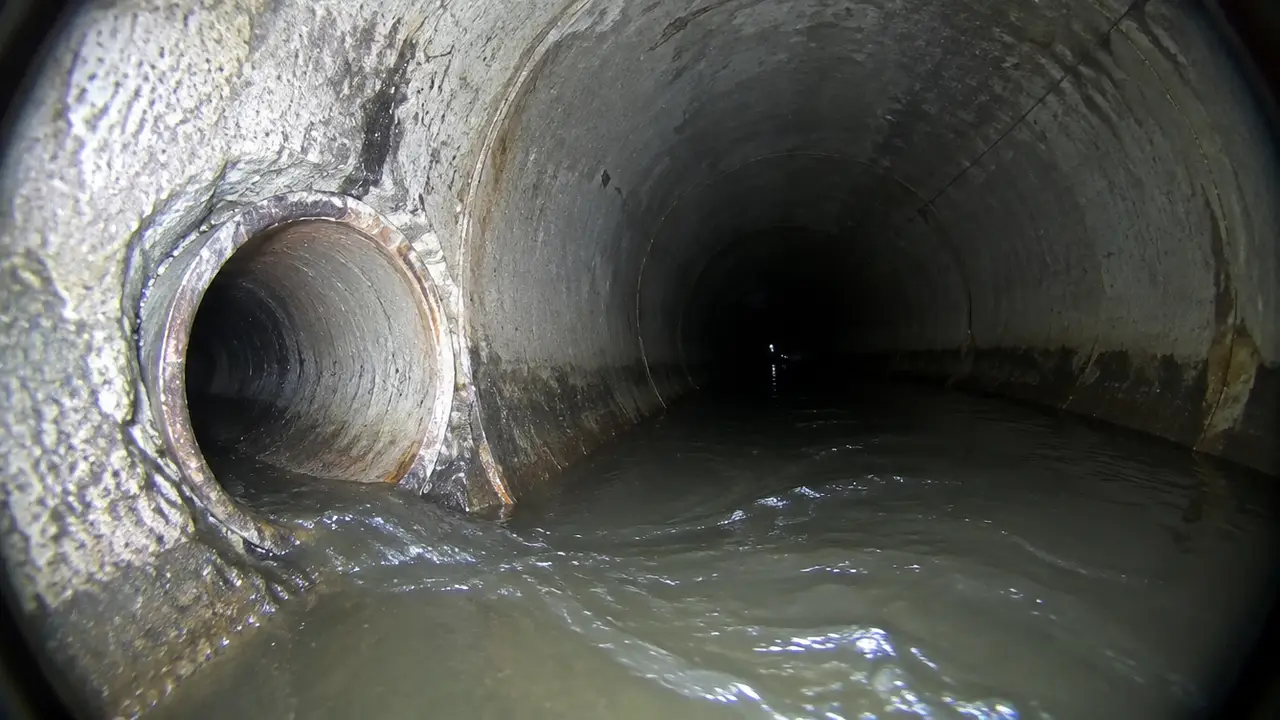
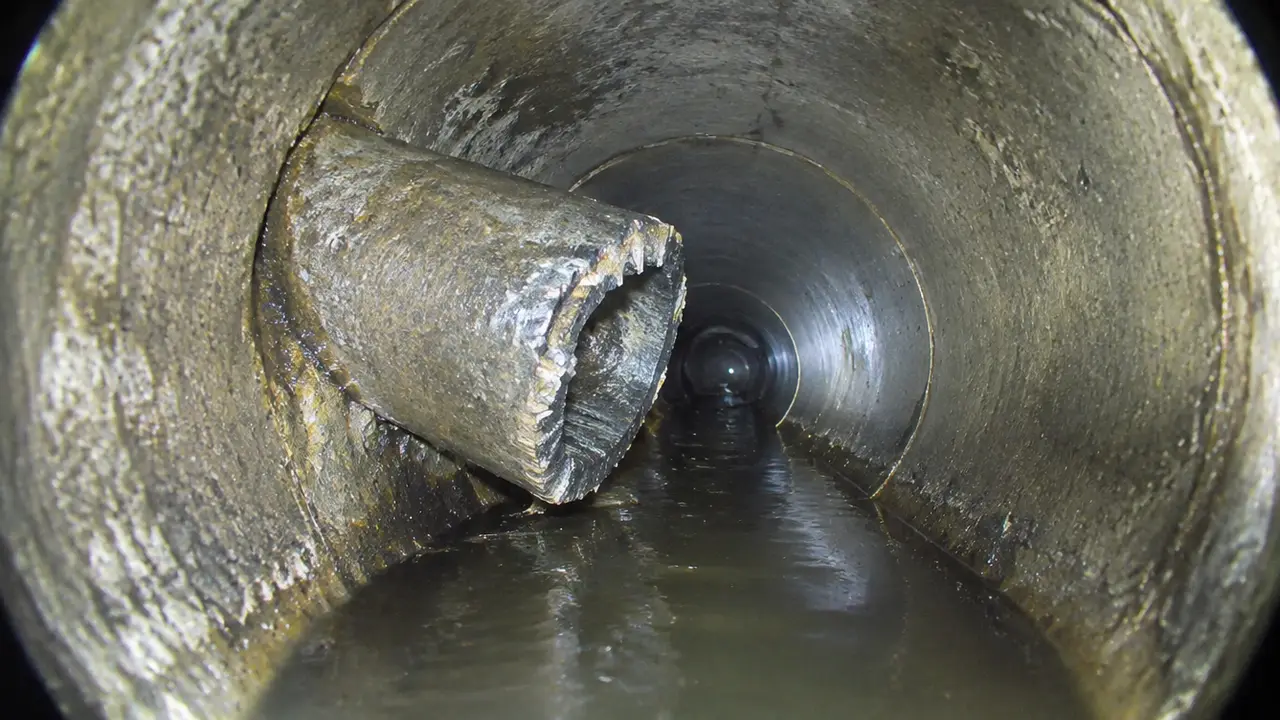
The Iowa SUDAS design manual lays out the sequence most engineers follow. First, the line is cleaned, typically by water jetting, and televised with closed-circuit TV to record the location, type, size and severity of each defect: breaks, cracks, offsets, collapses and corrosion, plus obstacles such as roots or protruding laterals and the location of every service connection. Manholes are inspected for cracks, deteriorated benches, crumbling brick or concrete, and chemical attack.
Second comes capacity. The line's capacity is calculated from its size and slope, reduced for any bore loss the proposed method would cause, and compared with projected flows. Flows are measured in dry weather and during high groundwater and heavy rain to find inflow and infiltration. SUDAS draws a useful distinction: infiltration is groundwater leaking in through joints, manholes and cracks, and rehabilitation will likely cut it; inflow is water dumped in through improper connections such as downspouts or sump pumps, and lining does little about it, so smoke testing and disconnection work are needed.
02 /Which methods do municipalities use most?
| Job | Common methods | Why |
|---|---|---|
| Leaking or corroded gravity sewer main | CIPP lining | Little excavation; services reinstated robotically |
| Large sewer or culvert with spare capacity | Slip lining, segmental liners | Economical at large diameter; flow can often continue |
| Undersized sewer or water main | Pipe bursting | Same size or larger without a trench |
| Water main renewal | Structural CIPP, slip lining, bursting | Traffic and restoration savings |
| New gravity trunk | Microtunnelling, pipe jacking, tunnelling | Holds grade; avoids surface disruption |
| Road, rail and river crossings | Auger boring, pipe ramming, directional drilling | Casing or carrier under the obstacle |
| Manholes | Coatings, cast mortar, structural liners | Stops infiltration and corrosion |
Each method is covered in its own guide: CIPP, slip lining, bursting and splitting, microtunnelling, auger boring and ramming, directional drilling and coatings.
03 /What do Canadian cities actually do?
Three examples we verified on municipal sites in September 2026 show the range.
- Toronto, watermain lining. The City describes structural lining as a pipe within a pipe that extends a watermain's life and is best suited where open-cut costs and traffic disruption are significant. Its TS 7.60 specification covers structural CIPP lining of watermains up to 400 mm with a 50-year design life, NSF/ANSI 61 potable-water approval, temporary water services and CCTV at several stages.
- Calgary, service line lining and a microtunnelled trunk. The City's pilot sanitary lateral lining program renews service pipes by trenchless lining after a camera assessment and cleaning, with residents notified in person before work and asked to stop water use during installation. Separately, its 8.5 km TransCanada Sanitary Trunk is being built more than 85 percent by microtunnelling to avoid disturbing a highway sound barrier and existing trees.
- Toronto, storm relief. The Fairbank-Silverthorn project combines a tunnel-boring-machine storm trunk with local storm sewers built by microtunnelling along residential streets.
More city notes, including who owns which part of a service line, are on the across Canada page.
04 /What makes a municipal trenchless contract work?
SUDAS offers practical contract advice from the owner's side, especially for lining.
- Bundle quantities
Mobilisation is one of the largest costs in lining. SUDAS says lining large quantities, 1,000 feet or more, under one project significantly reduces unit cost, and suggests coordinating with neighbouring communities so one mobilisation serves several projects.
- Allow a flexible window
Lining contractors often cover large territories; a flexible schedule lets them group work and lower costs.
- Specify performance, not one product
SUDAS recommends allowing multiple resin strengths and liner thicknesses rather than one product, either by letting contractors design the thickness or by setting design requirements.
- Share the video
Make pre-lining CCTV available to bidders so they price the real condition.
- Set tolerances case by case
For new bores, tight tolerances cost more; allow as much grade and alignment variation as the pipe's function allows.
- Allocate risk
Say in the specifications how unexpected ground or obstructions will be handled, and include soil boring logs.
05 /How do commercial and institutional owners use trenchless?
A shopping centre, campus, hospital or industrial site faces the same technical choices as a city, with different constraints. Tenants and operations cannot stop for long; loading docks, fire routes and parking must stay open; floors inside buildings may carry equipment or finishes worth more than the pipe. Trenchless methods that work from a few access points fit those sites well.
- Private sewer mains and building drains. CIPP lining from cleanouts and manholes keeps parking lots and floors intact; the building's connections are reinstated from inside.
- Storm systems and culverts. Slip lining or lining under driveways and private roads avoids closing access.
- New services to an expansion. Directional drilling or boring can bring a water or gas service across a lot without trenching through paving.
- Crossings of public roads or rail. These usually need permits and casing designs approved by the road or rail authority.
Private-side responsibility matters here. In Winnipeg, for example, the City says property owners own the sewer pipe serving their property all the way to the main, including the part under the street, and are responsible for its maintenance and repair. Other cities split ownership at the property line. Confirm the split with the municipality before scoping any work.
06 /What does municipal and commercial trenchless cost?
It is priced by tender or negotiated contract, not by published ranges. Diameter, length, depth, traffic control, bypass pumping, the number of service reinstatements, ground conditions and the number of mobilisations drive the price. SUDAS notes that the cost of CIPP can approach or exceed open-cut replacement in some situations, and that the reason to choose it is the reduced disruption, which is hard to price but real for residents and businesses.
For the residential side, where published planning ranges do exist, see the trenchless sewer cost guide. For weighing disruption, use the Dig vs Trenchless Disruption Calculator and read trenchless vs open cut. Property managers can send a scope and camera footage for next steps.
07 /What happens to house connections when a city renews a main?
It depends on the method. When a main is lined with CIPP, the liner covers every service opening, and a remote-controlled cutter reopens each one from inside; SUDAS notes that a small dimple is usually left in the liner over each connection so it can be found, and that connections are recorded on the pre-lining video so none are missed. When a main is burst or slip lined, each service is excavated, disconnected before the work, and reconnected afterwards, with temporary service where needed.
Either way, the joint between the private service and the renewed main is a critical detail. If a city is lining its main on your street, it is a good moment to have your own lateral inspected: a lined main and an old, leaking private lateral still leave a weak point at the connection. Residents usually receive notice before the work, with instructions on water use; keep it, and ask the contact on it whether your connection will be reopened and sealed.
FAQQuestions people ask
How is a sewer main replaced without digging up the street?
Usually by lining it with CIPP from manholes, slip lining it, or bursting it between pits, with flow bypassed and each service reconnected. New trunks are often microtunnelled.
Why does the city line a main but not my service line?
Ownership. Many cities own the main and part of the connection, while the private portion belongs to the property owner. Some run lateral programs; ask yours.
Does lining a sewer main stop basement flooding?
It can reduce groundwater infiltration into the main, but not inflow from roof drains or sump pumps, and it does not fix a blocked private line. Flooding has many causes.
What is bypass pumping?
Temporary pumps and hoses that carry sewage around the section being worked on, so homes and businesses stay connected while the main is out of service.
Can a commercial parking lot sewer be fixed trenchless?
Often, by lining from manholes and cleanouts or bursting between pits, which keeps most of the lot open. Collapsed sections and sags still need a dig.
NETWORKGo deeper across the HAUSE Sewer network
Condo and apartment drain stack cleaning
Condo and apartment drain stack cleaning: why kitchen stacks back up on lower floors, how stacks are jetted or descaled, and how boards schedule it.
SewerQuotes.comSewer cost estimator
Free sewer cost estimator: choose the job, length, depth, access and surface to get a CAD planning range with the cost drivers behind it, then test real quotes.
SewerInspector.caCCTV sewer inspection: crawlers, lateral launch cameras and coded surveys
What CCTV sewer inspection is: crawler cameras, lateral launch and zoom cameras, PACP-coded municipal surveys, and what city camera work means for your lateral.